Well Pump, Tank and Water Services

Everything we do starts with a private well that is already in the ground and not doing its job.

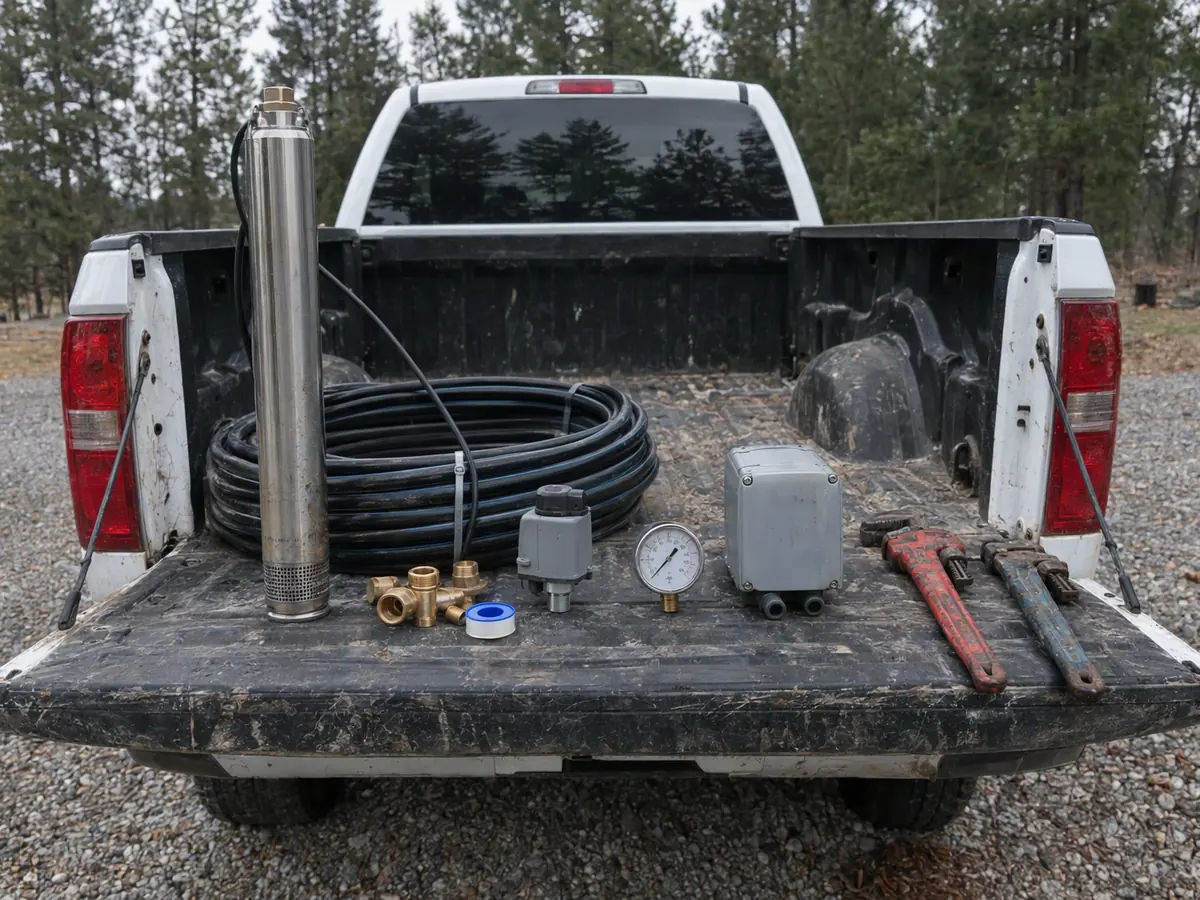
Well pump parts laid out on a truck tailgate

Begin with what you see at the tap, not the name of a part. Sorting out which part failed is our end of it.

Begin with the symptom, not the part

Most people call knowing what the water is doing, not which part quit, and that is the right way around. One complaint can come from several places, so the symptom is the better place to start.

  • No water anywhere in the house. Treat it as a no-water emergency and call. Power, the switch, the control box, the pump, the pipe, or a well that has been pumped down can all cause it.
  • Weak pressure that crept up on you. Usually pump repair, sometimes a clogged filter or a leak in the pipe down the well. We find out which before anything is replaced.
  • A pump that clicks on and off with every glass of water. Start with the pressure tank. A tank short on air is the usual culprit.
  • Stains, odors, or a bad taste. A lab test comes first. Treatment follows, matched to the result.
  • A house you are about to buy. A well inspection, with a drawdown and recovery test and a water sample.
  • A well that runs short every summer. An inspection shows what the well can actually give. Rehabilitation or hydrofracturing may bring more water back.

If your problem is not on that list, describe it the way you would to a neighbor. That is plenty to start with.

What a first visit usually involves

The visit starts before anyone arrives. On the phone we ask what the water is doing, when it started, whether a storm or outage came first, and what the tank gauge reads, if you have one.

At the house, the technician looks at the whole system, not only the part you suspect. That means the breaker, the pressure switch, the tank and its air charge, the control box on a three-wire pump, and the wellhead outside: the cap, how high the casing stands, and which way the ground slopes around it. Readings at the surface rule parts in or out before the well is opened.

Then you get an explanation in plain words: what failed, what probably caused it, and what the choices are. Nothing gets replaced until you agree. If the well is opened for pump work, it is disinfected before we leave, and we will tell you when a follow-up water test makes sense.

Where well work ends and another trade begins

Two kinds of jobs sit outside what we do, and it saves everyone time to say so up front. New wells are not our work: when a property needs one, a driller bores it, and the permit comes from the local health department. The pipes inside the house are not our work either. Our work runs from the pump at the bottom of the well to the tank, the controls, and the treatment gear in the house. Past that point, the lines to your sinks, showers, and outdoor spigots belong to another trade.

The two well licenses behind the work

The well work runs on two credentials: North Carolina water well contractor certification 2453-A and Virginia water well license 2719001436. Both states care who touches a well. In North Carolina, well contractor activities need a certified contractor on site, and that covers breaking the well seal, the disinfection that follows pump work, extending casing, hydrofracturing, and well repair. The commission that certifies them sits under NC DHHS. Virginia's rule is that anyone building, repairing, or altering a private well must be licensed and certified, through the Department of Professional and Occupational Regulation. The company is bonded and insured as well.

What is down there, and what can go wrong

Tap a part, or pick one from the numbered list, to see what it does. Press "Run the pump" to watch the water move.

How a private well system works Cutaway of a drilled well: cap and casing above the ground, a pitless adapter below the frost line, a submersible pump hanging in water-bearing bedrock, and a buried line to the house where the pressure tank, pressure switch, control box and treatment sit. TOPSOIL RED CLAY AND WEATHERED ROCK BEDROCK frost line water level
  1. A sealed, vented cap keeps out rain, insects and small animals. A cracked or loose cap is one of the easiest ways for bacteria to get into a well.

    Well Repair, Casing Repair and Well Liners
  2. Pipe that lines the top of the well and seals it from surface water and loose soil. It should stand above the ground, never be buried.

    Well Repair, Casing Repair and Well Liners
  3. The fitting on the side of the casing, below the frost line, where the water line leaves the well for the house.

    Well Pump Troubleshooting and Repair
  4. Sits down in the water and pushes it up to the house. Most drilled wells use one. Shallow wells and some older systems use a jet pump above ground instead.

    Well Pump Installation and Replacement
  5. Carries water up and power down. A split pipe or a bad splice can look exactly like a dead pump.

    Well Pump Troubleshooting and Repair
  6. In the Piedmont, wells draw water from cracks in the bedrock. Hydrofracturing can open more of them in a well that gives too little.

    Well Rehabilitation and Hydrofracturing
  7. Holds water under air pressure so the pump does not start every time you open a tap. A tank that has lost its air makes the pump short cycle.

    Pressure Tank Installation, Replacement and Tuning
  8. Turns the pump on at the low setting and off at the high one. Pitted contacts or a clogged sensing tube stop the whole system.

    Pressure Switch, Control Box and Wiring Repair
  9. Three-wire pumps have a control box on the wall with the start parts. Two-wire pumps do not.

    Pressure Switch, Control Box and Wiring Repair
  10. Filters, softeners and disinfection go after the tank. A lab test tells you which one, if any, you need.

    Well Water Treatment Systems

Questions about our services

Still stuck? (336) 613-4314

Do I need separate companies for the pump, the tank, and the water treatment?

No. All three belong to the same well system, and we work on all of them, along with the pressure switch, the control box, the wiring, and the casing. One company looking at the whole thing helps, because a fault in one part often shows up as a symptom somewhere else. A waterlogged tank, for example, can wear out a perfectly good pump.

My well gives less water than it used to. Can that be fixed?

Sometimes. First we find out whether the well is short or the equipment is. A drawdown and recovery test tracks the water level as the pump runs and again as the well refills. If the pump and pipe check out and the well itself is weak, rehabilitation or hydrofracturing can open more of the rock fractures that feed it. Not every well responds, and we will tell you if yours is unlikely to.

Will you put in a softener or filter before the water is tested?

We would rather not. Iron, manganese, hardness, low pH, and sulfur odors each call for different equipment, and a guess can leave you with a unit that does not touch the real problem. A lab test tells you what is in the water and how much. We can take the sample, go over the results with you in plain words, and size the treatment to what the report shows.

Can I book a yearly checkup before anything breaks?

Yes. The National Ground Water Association suggests a once-a-year checkup by a licensed or certified water well professional: a flow test, a look at pump motor performance, the pressure tank and switch, and a coliform and nitrate test. A scheduled inspection is easier on everyone than a no-water call, and it is the best chance to catch a tank or switch that is starting to slip.

Is the work any different on the Virginia side of the state line?

The equipment is the same, and so is the way we troubleshoot it. The rules are not. Since November 6, 2024, Virginia has required a written permit for building, altering, deepening, or abandoning a private well, and a pump replacement is not treated as an alteration. Our Virginia water well license is 2719001436, and the Virginia page on this site covers those rules in more detail.

Can you raise a well casing that ends at or below the ground?

Yes. North Carolina wants at least a foot of casing above the ground, and Virginia sets the same 12-inch minimum. Casing that has been buried or cut low lets surface water and insects reach the well. In North Carolina, raising casing is a job for a certified contractor, and we check the cap and the grading around the wellhead while we are there.

What happens if the problem turns out to be inside the house?

We tell you. If the well, the pump, and the tank are doing their jobs and the trouble starts past the pressure tank, it belongs to a different trade. We will say so rather than sell you work on a well that is fine, and we will show you the readings that cleared the well system so you can pass them along to whoever you call next.

Can you check a well for someone who is buying the house?

Yes, and before closing is the time to do it. A buyer's inspection looks at the wellhead, the casing height, the cap, the pressure tank, the switch, and how the pump performs, and it includes a drawdown and recovery test to show how the well holds up under steady use. Pair it with a lab water test. Together they tell you what you are buying.

Good references

Official pages we point homeowners to. They open in a new tab.

No water, low pressure or bad taste?

Call or text. Monday to Friday, 8am to 5pm. Saturday and Sunday: call or text.