Well pump repair in Greensboro and the Triad.

We keep existing wells working from Asheboro north to Danville and Martinsville, Virginia. We do not drill new wells.

(336) 613-4314

Call or text. Monday to Friday, 8am to 5pm. Saturday and Sunday: call or text.

See how your well works, part by part
How a private well system works Cutaway of a drilled well: cap and casing above the ground, a pitless adapter below the frost line, a submersible pump hanging in water-bearing bedrock, and a buried line to the house where the pressure tank, pressure switch, control box and treatment sit. TOPSOIL RED CLAY AND WEATHERED ROCK BEDROCK frost line water level

No water? Try this first

  1. Check one faucet, then another.

    If only one is dry, the well is probably fine.

  2. Find the well breaker.

    Give it one reset. A second trip means leave it off and call.

  3. Read the tank gauge.

    Near zero with the power on means the pump is not pushing water.

Still dry? Call (336) 613-4314. Tell us what you already checked. It tells the technician where to look first. Or walk through the full checklist.

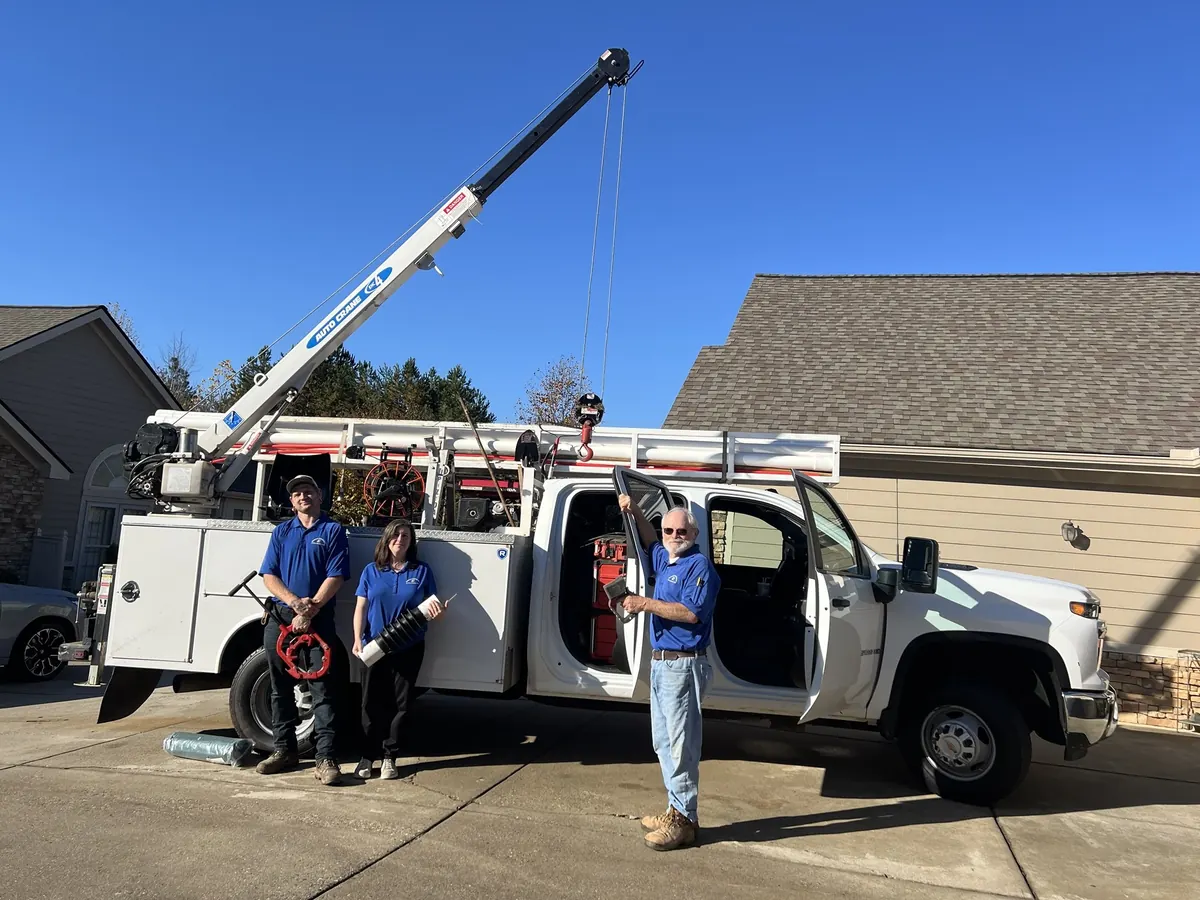
Our crew beside the service truck with its crane boom raised
Our service truck and its crane.
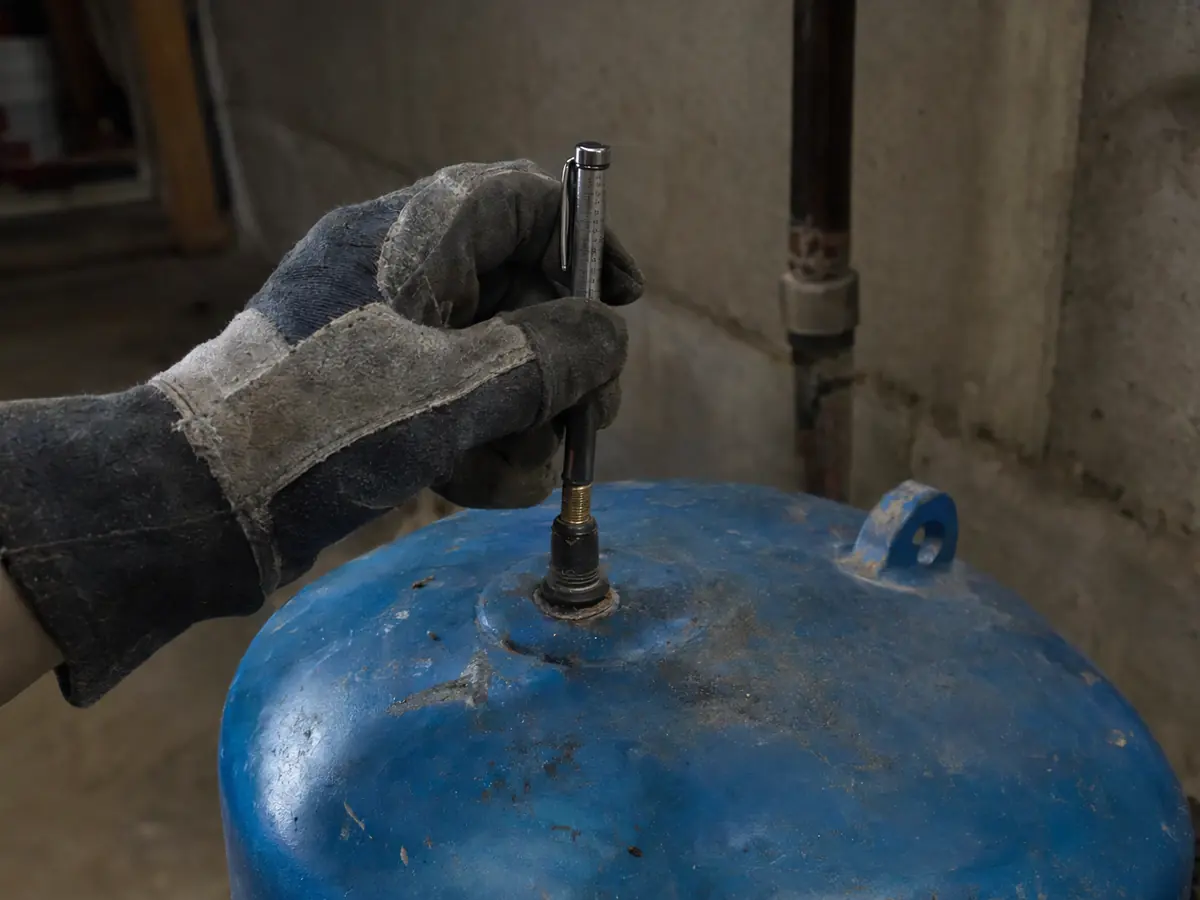
Gloved hand checking a pressure tank's air valve with a tire gauge
Checking a pressure tank's air charge.
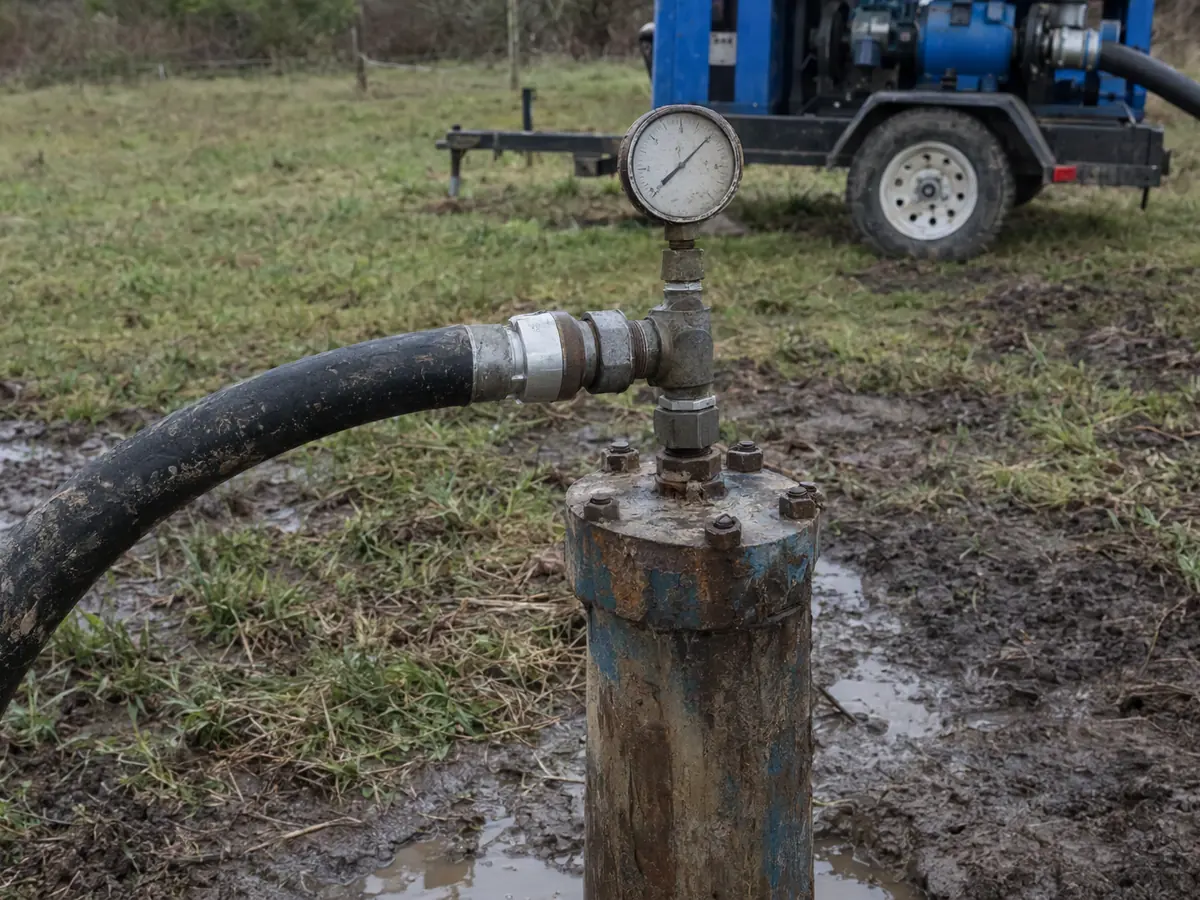
High-pressure hose and gauge connected to the top of a well casing
A pressure hose on a well casing.

Know someone on a well?

Send them our way. When they give us your name, you get a $100 gift certificate toward a future job with us.

How referrals work

Check it yourself first

Two quick checks you can do before you call. Nothing here asks you to open a cover or touch wiring.

What should my tank read?

Bladder and diaphragm tanks are set about 2 psi below the pressure switch cut-in. Pick your switch setting.

Pressure switch setting (cut-in / cut-out, psi)

psi

28 psi

Target air charge, checked with the pump off and the water drained to zero.

How to check it safely
  1. Turn the pump breaker off.
  2. Open a faucet near the tank and let it run until the water stops and the gauge reads zero.
  3. Take the cap off the air valve on top of the tank and check it with a tire gauge.
  4. Add air with a compressor, or let a little out, until it matches the number above.
  5. Close the faucet and turn the breaker back on.

If water comes out of the air valve, the bladder inside has failed and the tank needs to be replaced. Stop there and call us.

What is your water doing?

Pick what you are seeing. These are common causes, not a diagnosis. A lab test is the only way to know.

Smells like rotten eggs

Usually hydrogen sulfide gas or sulfur-reducing bacteria in the well. It is unpleasant more than dangerous at the levels most homes see, but it can corrode metal and it tells you something in the well has changed.

What to test for: Hydrogen sulfide, sulfate and a bacteria test

Well Water Treatment Systems

All well owner tools, including the no-water checklist and the well explorer.

Run by a tradesman

The founder still owns and runs the company, and has been a licensed tradesman since 1974. Our office manager answers your call, and for a technical question gets the right person on the phone and books you directly with them.

Our people make the difference. From the initial phone or email contact until our technician drives away we do our best to make our clients comfortable and treat their homes as if they were our own.

Our founder

North Carolina well contractor certification 2453-A
Virginia well license 2719001436
Bonded and insured to $2 million

About the company

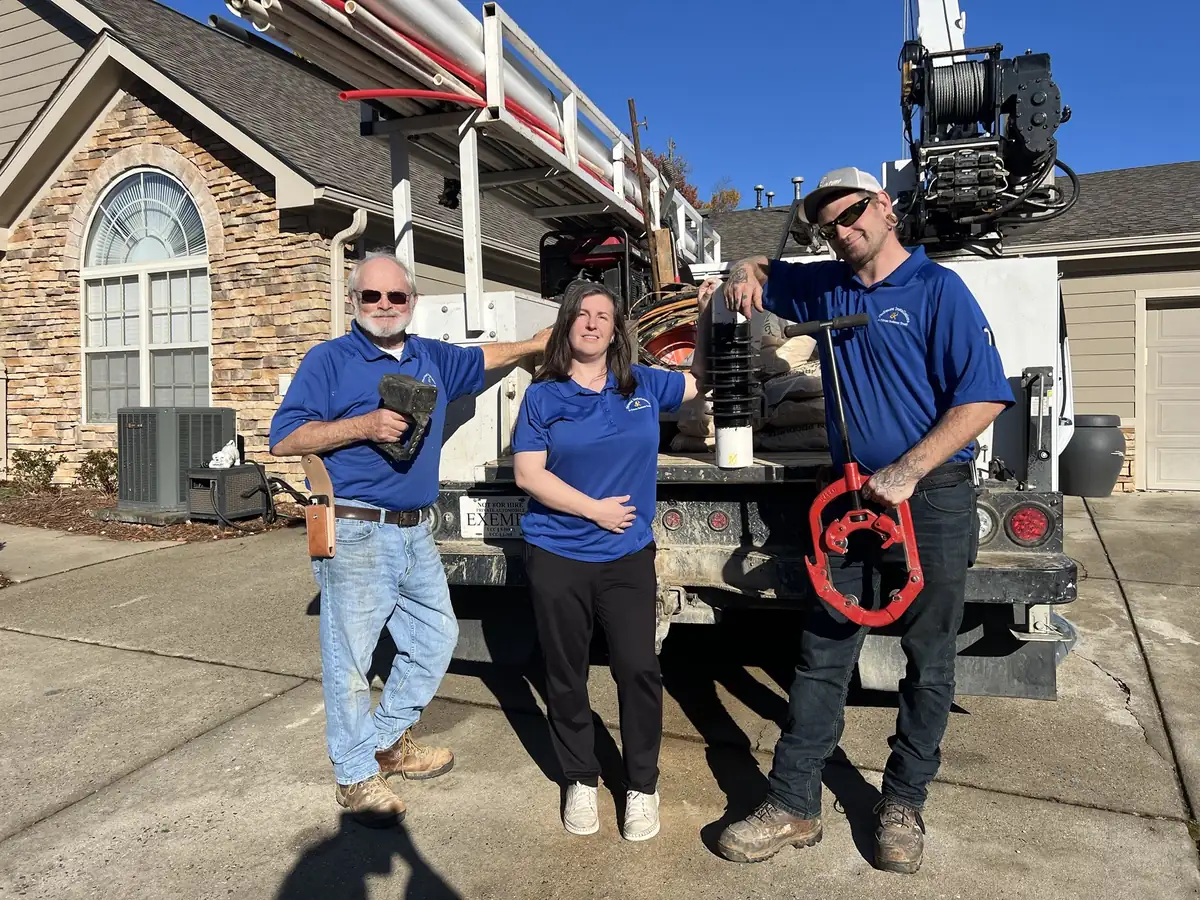
Our crew at the service truck, holding a pipe cutter and well parts

What customers said

Installer very knowledgeable and precise in his work. Polite in communications and did not waste time. I would recommend him to any customer.

Margaret, Winston-Salem

Doug was very knowledgeable in everything I asked him. He made me feel that I had made the right choice going with your company. I will definitely recommend this company. I appreciate the quick service.

Lisa, Greensboro

Kind words customers sent us, carried over from our earlier website.

Where we work

Ten counties across the Triad, the northern Piedmont and Southside Virginia, plus a few towns just past the county lines. If you are on a well anywhere on this map, call.

Map of the Piedmont Well and Water Services areaGreensboroHigh PointWinston-SalemStokesdaleOak RidgeReidsvilleEdenAsheboroMadisonDanvilleALAMANCEDAVIDSONGUILFORDRANDOLPHYADKINPATRICKCHATHAMDAVIEROWANSTOKESFRANKLINCASWELLPITTSYLVANIASURRYHALIFAXHENRY
Every dot is a town we serve, and the larger towns are named. The diamond is Greensboro.

No water at the taps. Pressure that fades halfway through a shower. A pump that clicks on and off and will not quit. We track down why and fix it. Our founder has worked as a licensed tradesman since 1974.

Well pump repair in Greensboro for homes off the city system

Greensboro's public water comes from three city lakes, Lake Higgins, Lake Brandt, and Lake Townsend, all up in the northern part of Guilford County. Most addresses inside the city drink from that system and never think about a pump. Our pump calls come from the places it does not reach: houses at the edges of town and along the county roads past the city line.

There is a lot of that county. Guilford County's long-range plan, adopted in 2025, describes about 658 square miles that are still fairly rural, with its cities and towns holding most of the people on less than half the land. The rest of the land is unincorporated. The county does not sell water, and for areas unlikely to get community lines, the plan expects private wells and septic systems to carry on. On those lots, the pump in the well is the whole water system.

That changes who keeps an eye on it. The city's annual water quality report covers the public lakes and plants, not the water under your yard. Nobody checks your pump, tank, or switch unless you ask someone to.

How we track down a pump problem

A submersible pump sits deep in the well, which makes it the last part we blame. Most of the clues are above ground, and we read them in a set order.

What you tell us. When it started, what the taps are doing, whether a storm came through, and whether the breaker tripped. A pump that quit in a thunderstorm points one way. Pressure that faded over a month points another.

The tank and the gauge. We watch the needle through a full cycle. If it drops fast and the pump kicks on every few seconds, the tank has probably lost its air. If it climbs slowly and never reaches cut-out, the pump or the pipe is not keeping up.

Power and controls. Voltage at the breaker and the pressure switch comes first, then the switch contacts, and on a three-wire pump, the control box on the wall. A two-wire pump keeps its starting parts inside the motor, so there is no box to test.

Down-hole wire and motor. From the wellhead, a meter on the well leads shows whether the wire running down to the pump is whole and whether the motor windings are sound. A bad splice or a motor hit by lightning shows up here.

The pump, the pipe, and the water. Amp draw and flow tell us how hard the pump is working and what it delivers. If the motor is healthy and pressure still will not build, the next suspects are the drop pipe, the check valve, and the pitless adapter seal. Last comes the water level, because a good pump in a well that has been drawn down has little to deliver.

By the time anything is pulled out of the ground, we can usually tell you why.

Repair or replace, and how we decide

Plenty of pump calls end with the pump still in the well. Pitted switch contacts, a dead capacitor in the control box, or a tank with a torn bladder can make a healthy pump look finished. Those parts get replaced above ground, and the pump goes back to work.

When the readings point at the pump itself, the choice narrows. A submersible motor whose windings read shorted or open cannot be rebuilt in your yard. A pump that runs but draws low current and moves little water is worn out inside. Either one gets replaced. A jet pump is a different case: it sits above ground, and a bad seal or impeller can sometimes be serviced where it sits.

The gray area is a pump that still works but is losing ground. Here we weigh its age (if anyone knows it), how much orange or black scale it carries, and whether it has been running short of water because it pulls harder than the well can give. A pump sized past what the well supplies will keep wearing out early, so the better answer may be a smaller pump or work on the well, not a copy of the old one.

You see the meter readings, and if the pump comes up, you see the pump. Then you decide. Under North Carolina rules, anyone who repairs or installs a pump in a well must disinfect the well afterward, so we do that before leaving. A lab test later tells you the water came back clean.

Tanks, switches, casing, and the water itself

The pump is one part of a system, and we work on the rest of it too. Pressure tanks that have lost their air. Switches with burned contacts. Casing that is cracked, or cut off too close to the ground. Water that needs a lab test before anyone mentions a filter, and treatment sized to what the test found. One call covers the well from the cap to the last filter in the line.

Who you get on the phone

Piedmont Well and Water Services is a small independent company based in Greensboro. Its founder still owns it. Our office manager answers the phone and books the visits. Have a technical question? The office manager gets the right person on the line and puts your visit on that person's schedule. Expect a few questions: what the water is doing, when it started, what town you are in, and what you have already checked. Those answers tell the technician where to look first.

Office hours run Monday to Friday, 8am to 5pm. Weekends, call or text (336) 613-4314. If the house has no water at all, lead with that.

From the Triad up into Southside Virginia

We start from Greensboro and work across the Triad counties, north through the rest of the northern Piedmont to the state line, and over it into Southside Virginia, where Danville, Ridgeway, and Martinsville are part of our area. Danville is 41.8 miles from Greensboro in a straight line, and Martinsville is 43.0. A few towns just past our county lines are on the list as well. The region map on this page shows them all, and each town page covers its water lines, its wells, and the health department that handles permits there.

Two things we do not do

We do not drill new wells. If a well cannot be saved, or a lot needs its first one, that is a job for a well driller, and the local health department handles the permit. What we do is keep existing wells working: the pump, the tank, the controls, the casing, and the water.

We also stop at the edge of the well system. Past the pressure tank, the switch, and any treatment equipment, the pipes that run through the house to your sinks and showers belong to another trade. If the trouble is in the house piping, we will tell you plainly instead of selling you a well repair you do not need.

Wells are the only work we take on.

Questions well owners ask

Still stuck? (336) 613-4314

Can a well pump be fixed without pulling it out of the well?

Often, yes, because the trouble is frequently somewhere else. Pressure switches, control box parts, capacitors, surface wiring, and pressure tanks are all replaced above ground. A meter at the wellhead shows whether the motor and its wire are still good before the cap comes off. A submersible pump that has truly failed has to come up to be replaced.

Will a pump replacement need a Guilford County permit?

No. Under state law, repairing or replacing a pump or a pressure tank needs no repair permit, and neither does maintenance that leaves the well seal closed. Casing repairs and other work on the well itself are different, and those take a permit from Guilford County Environmental Health. A pump job still comes with one rule attached: the well gets disinfected once the work is finished.

Does the city's water quality report say anything about my well?

No. The City of Greensboro's annual report covers the public system, which draws on Lake Higgins, Lake Brandt, and Lake Townsend. A private well draws on cracks in the rock beneath your property, and once a new well has had its first test, any testing after that is your call. NC DHHS suggests checking for coliform bacteria yearly, with heavy metals, nitrates, nitrites, lead, and copper every other year.

Who can test my well water in Guilford County after a pump repair?

A certified lab can, and so can the county. Guilford County's Environmental Health office tests private wells for bacteria, inorganics, petroleum, pesticides, and nitrates or nitrites, with county staff coming out to take the samples. Bacteria results usually arrive late in the same week. Everything else is sent to the state lab in Raleigh, which takes about four to six weeks. We can collect a sample for you as well.

Why does my pump keep running while the pressure never comes up?

Either water is escaping between the pump and the tank, or the pump cannot move enough of it. The usual suspects are a split or separated drop pipe, a leaking check valve or pitless seal, a worn pump, or a well whose water level has dropped. If it runs nonstop with weak or no flow, turn the breaker off. A pump without water around it overheats.

How long can a pump keep short cycling before it fails?

There is no safe number. Every start hits the motor with a burst of current and heat, and the switch contacts arc each time, so a pump starting every few seconds is spending its life far faster than it should. Most of the time the cause is a tank that has lost its air cushion, a far smaller job than a pump. Get it looked at while it is still a tank problem.

Do you work on pumps in older wells around Greensboro?

Yes. Age alone does not rule out a repair. When a pump comes out of an older well, we also look over the casing, the cap, and how high the wellhead sits. State rules want at least 12 inches of casing above the ground, and an older well that was graded over or cut low can let surface water in. Those are worth fixing while the well is open.

Will you work on a pump that another company installed?

Yes. Who put the pump in makes no difference. We work on existing submersible and jet pump systems, along with the tanks, switches, and control boxes that run them. If you have paperwork from the last job, such as a receipt or a well record, keep it handy. It can tell us the pump's size and how it was set before anyone opens the well.

Good references

Official pages we point homeowners to. They open in a new tab.

No water, low pressure or bad taste?

Call or text. Monday to Friday, 8am to 5pm. Saturday and Sunday: call or text.