
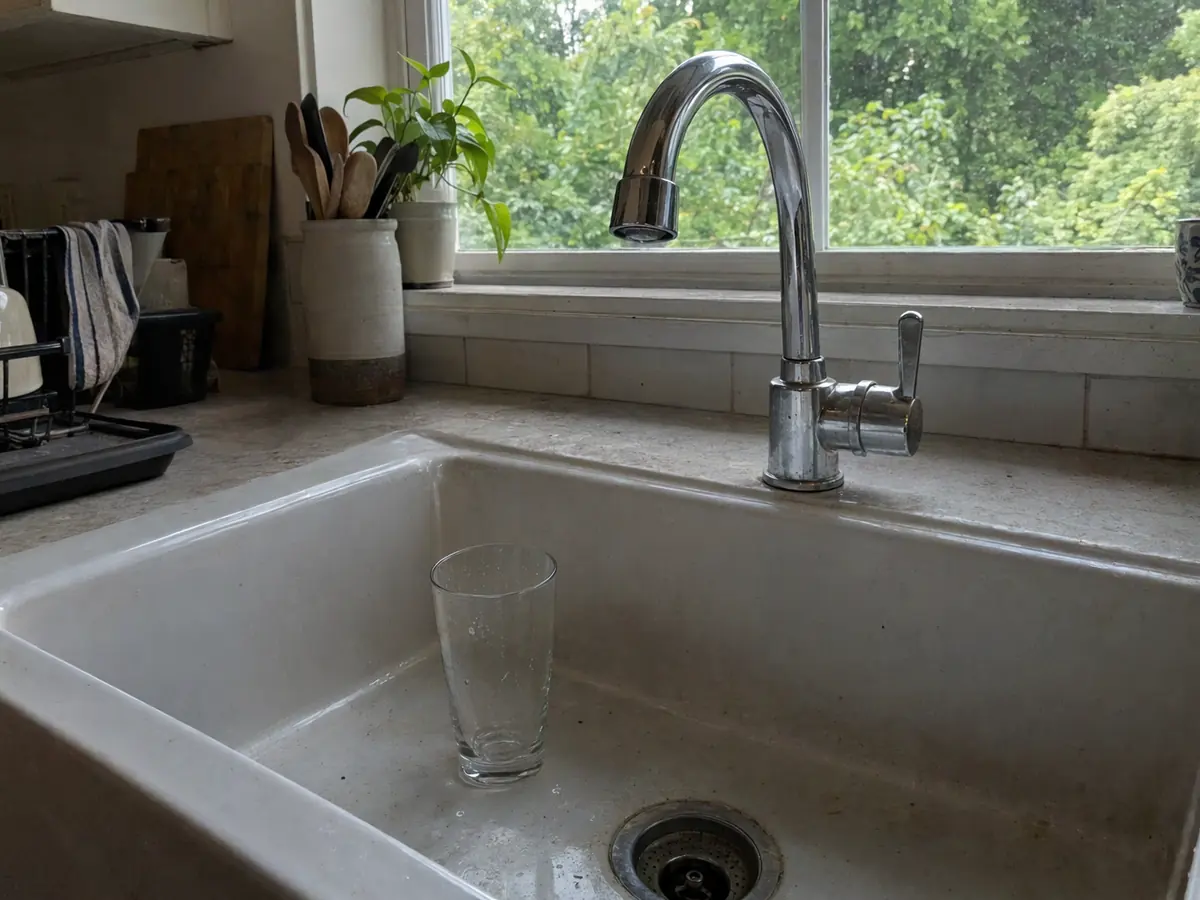
This is what to do when your well stops working, in the order a well technician would check it, plus what to leave alone.
First, find out how much of the house is dry
Try a few taps, including one outside. If only one is dry, the trouble is in that line, not the well. If water comes out everywhere but only as a trickle, a clogged sediment filter or treatment unit may be choking the flow. Many have a bypass valve, and switching to bypass is a fair test. If nothing runs anywhere, the problem is the pump, its power, or the well.
Think back over the last day, too. A thunderstorm, a power outage, someone digging in the yard, or a long dry spell are all clues worth remembering.
Check the power before blaming the pump
- If the whole house lost power, the pump did too. Water should return with the power.
- Find the well pump breaker in the main panel. It is usually a two-pole breaker and may be labeled for the well or pump.
- If it has tripped, push it fully to off, then back on. Do this one time only.
- A second trip means stop there and leave it down. Something is drawing too much current, and repeated resets can finish off a motor.
- Some homes also have a separate disconnect near the tank or in the well house. If it is off, someone may have turned it off for a reason, so ask before switching it on.
What the gauge on the tank can tell you
With the breaker on, look at the pressure gauge near the tank.
- Zero, with no sign the pump is running. The pump is not getting power, or the switch is not calling for it. Time to call a technician.
- Low and climbing slowly. The pump is running but struggling. It may be worn, or the well may be low. Close all taps and see if it reaches cut-out.
- Normal pressure, no water at the taps. The well side is fine. Look for a closed valve or clogged filter between the tank and the house.
- Needle jumping up and down fast. The pressure tank has likely lost its air charge.
Switches that shut the pump off on purpose
Some pressure switches have a built-in low-pressure cutoff, often with a small lever on the side. When pressure falls very low, the switch shuts the pump off and keeps it off to protect it.
A switch that has tripped this way is a symptom, not the problem. Something made the pressure crash: the well ran low, a pipe broke, or the pump is too weak to keep up. Restarting the pump over and over without finding the cause can run it dry and burn up the motor. If your switch has shut off like this, say so when you call. It narrows the search.
Things that make a dry morning worse
- Do not take the cover off the pressure switch or the control box. Both carry live current.
- Do not keep resetting a breaker that trips.
- Do not take the cap off the well. Wires run under it, and an open well lets in bugs, dirt, and surface water.
- Do not pour water down the well to prime a submersible pump. It does nothing for the pump and can carry contamination in.
- Do not try to pull the pump. It hangs on heavy pipe and wire, and dropping it down the well turns a repair into a much bigger job.
- If floodwater reached the wellhead, do not turn the power back on until the water has gone down. NC DHHS gives the same advice.
Getting by until the water is back
Keep bottled water for drinking and cooking, and fill a few jugs or buckets for washing up. A neighbor may be willing to fill containers from an outside spigot.
When water returns, expect some sputtering and cloudiness as air and sediment clear the lines. Run a cold tap until it settles. If the outage involved a pump repair, flooding, or work on the well, hold off on drinking it. North Carolina rules require disinfection after pump work, and NC DHHS recommends testing after any repair and after a flood.
When a dry house needs a well contractor
Call a well contractor if the breaker trips again, the gauge reads zero with the power on, the water came back sandy or muddy, floodwater reached the well, or you find a wet patch in the yard along the water line. Those are not problems to wait out.
Piedmont Well and Water Services handles no-water calls on residential wells. The office is open Monday to Friday, 8am to 5pm. On Saturday and Sunday, call or text (336) 613-4314.