
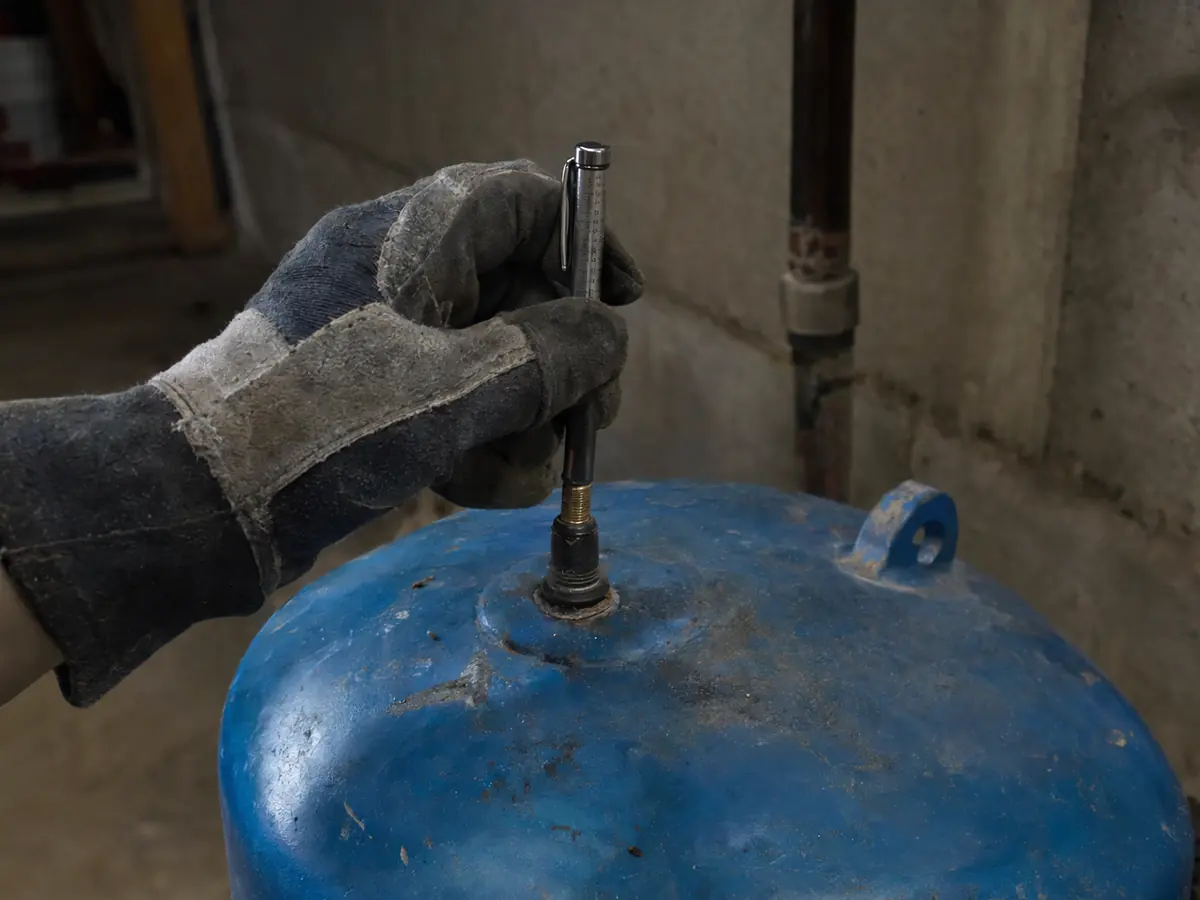
When that air leaks out, the pump pays for it. Below is how to check pressure tank air charge yourself, what you need, and what each reading means.
What the air in your tank is doing
Most modern well systems use a bladder or diaphragm tank. Inside the steel shell, a rubber bladder or diaphragm separates the water from a pocket of compressed air. When the pump runs, water fills the bladder and squeezes the air smaller. When you open a tap, that squeezed air pushes the water back out.
That stored push is what lets you wash your hands without the pump starting. The pump only kicks on when pressure falls to the switch's cut-in point, then runs until it reaches cut-out. A 30/50 switch starts the pump at 30 psi and stops it at 50 psi.
Too little air and the tank holds less water, so the pump starts more often. No air at all and it cycles every few seconds, which wears out pumps and switches.
Tools and setup before you test the charge
You need an accurate tire gauge, a bicycle pump or small compressor, and your cut-in pressure. If the switch setting is not printed on an outside label, have someone open a faucet while you watch the gauge near the tank. The reading where the needle stops dropping and the pump starts is your cut-in. Do not take the switch cover off to look. There are live terminals under it.
The test only works on an empty tank, because with water inside the gauge reads system pressure. These steps are for bladder and diaphragm tanks. An older galvanized tank with no bladder works differently.
Checking the air charge, one step at a time
- Shut off the pump. Turn off the breaker that feeds the well pump. It is often a two-pole breaker labeled for the well or pump. If nothing is labeled and you are unsure, stop and get help rather than guessing.
- Drain the water. Open the tap nearest the tank, or a hose bib on the line, and let it run until it stops. The pressure gauge should read zero.
- Find the air valve. It looks like the valve on a car tire, usually on top of the tank under a small cap.
- Take a reading. Press the tire gauge firmly onto the valve and note the number.
- Adjust it. Add air to raise the charge, or press the pin in the center of the valve to let some out. Recheck after every few strokes of the air pump.
- Restore water. Close the tap, turn the breaker back on, and watch the gauge climb to cut-out. The pump should shut off cleanly and stay off until you use water.
Setting the charge 2 psi below cut-in
The standard rule for bladder and diaphragm tanks is an air charge about 2 psi below the cut-in pressure. That way the tank pushes out its last bit of water just as the pump starts, and you never feel a dip at the tap.
- 20/40 switch: about 18 psi.
- 30/50 switch: about 28 psi.
- 40/60 switch: about 38 psi.
Go by what your system actually does, not just the label. Switches drift a little over the years. If the pump really starts at 32 psi on a switch marked 30/50, set the tank to 30 psi.
What your gauge reading is telling you
- Right on target. The tank is holding air. If the pump still cycles fast, look elsewhere.
- A few psi low. Normal slow loss. Top it off.
- Far low or zero. The air has escaped. Refill it and check again in a week or two. If it is low again that soon, the valve or the bladder is leaking.
- The valve spits water. The bladder or diaphragm has torn. More air will not fix it. The tank needs replacing.
- Higher than target. It was overfilled. Let air out until you reach the right number.
One more clue needs no tools. With the system full, knock on the tank from top to bottom. A healthy tank sounds hollow near the top. One that sounds dull and solid all the way up is full of water.
When adding air will not fix the tank
Some tanks are past saving. Rust spots, weeping seams, or a wet floor under the tank mean the shell is failing. A tank that loses its charge every few weeks has a leak that more air will only hide. And a tank too small for the pump cycles fast even with a perfect charge, which is common when a stronger pump goes in and nobody upsizes the tank.
If your reading points to a bad bladder, or you would rather not drain the system yourself, Piedmont Well and Water Services can check the charge, test the switch, and replace the tank if that is what it needs. Call (336) 613-4314.
Related reading: why a pump short cycles, a yearly well checklist, and repairing versus replacing. When the well needs a technician, start with well inspection.