
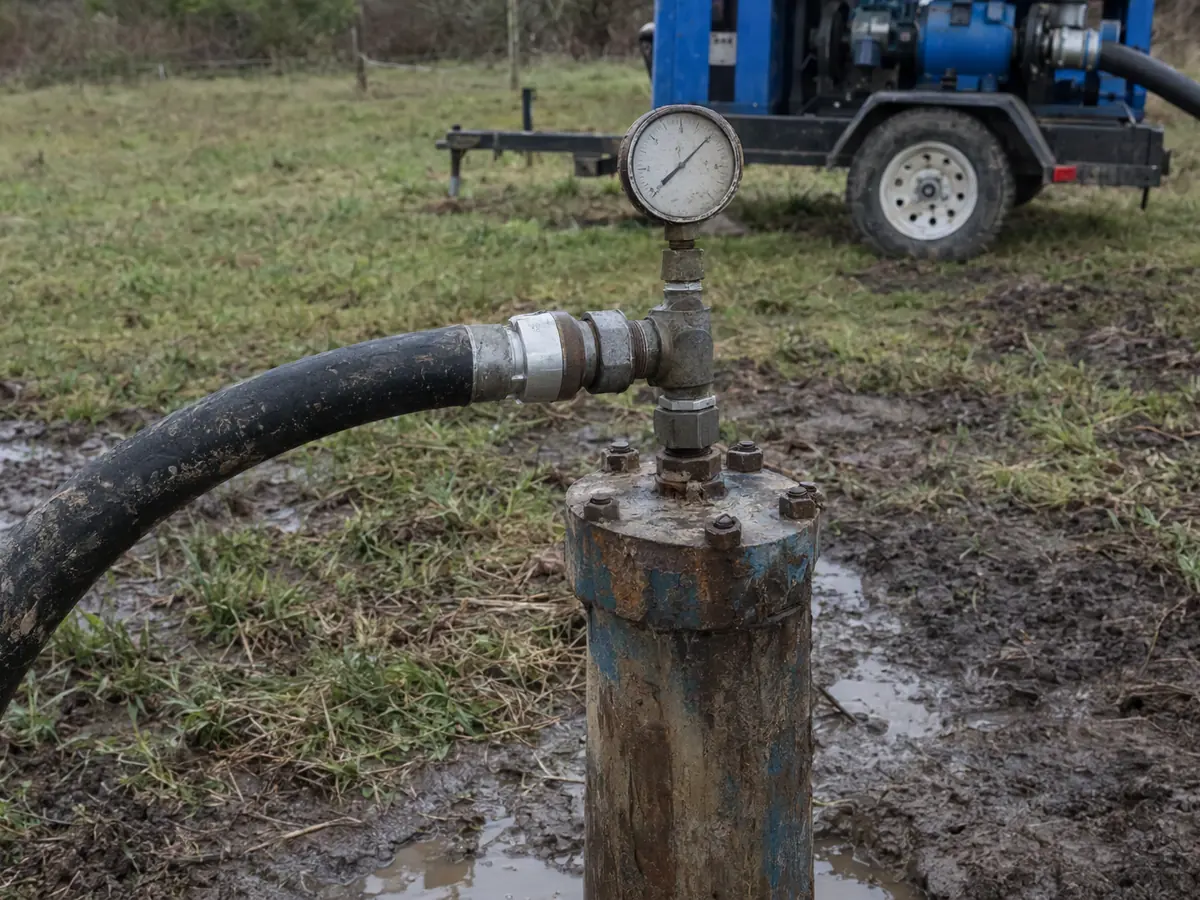
Well hydrofracturing pushes clean water at high pressure into the borehole to open and flush the fractures that feed it. We test first, rule out the equipment, and tell you plainly whether rehab is worth a try.
How a well tells you it is losing yield
A well rarely goes from plenty to nothing overnight. The signs build over months and show up first when the house uses the most water.
- Pressure is fine in the morning but fades halfway through the second shower.
- Taps sputter and spit air after a long run of laundry or lawn watering.
- The water turns cloudy or gritty after heavy use, then clears up overnight.
- The pump runs a long time to fill the tank, or shuts itself off and starts again later.
- Everything is worse in late summer and fall.
- You have started rationing without really deciding to: spacing out loads of wash, skipping the garden.
Any one of these can also come from a worn pump, a failed tank, or a bad switch. That is why the first visit is a diagnosis, not a sales call.
Why Piedmont rock gives some wells so little water
Geologists at the USGS describe the bedrock under most of the Piedmont as dense and nearly watertight. In solid rock the only openings that matter are fractures, the cracks and joints that cut through it, and that is where a well gets its water. Over the rock lies a blanket of weathered material and soil that holds more water but hands it down slowly.
A drilled well here is a hole through that rock, and it produces only what the fractures it crosses can deliver. Cross several open ones and the well may be strong for decades. Cross one or two thin ones and it may have been marginal from the day it was finished. A USGS fact sheet adds that wells in this crystalline rock tend to yield less than the region's other bedrock, since flow is limited to the cracks.
Even good fractures clog with time. Fine silt washes in from the weathered layer. Iron and manganese come out of the water and coat the openings. Bacteria build slime in the same places. The well did not run out of water; the doors got narrower.
Well hydrofracturing, step by step
Connecticut's Department of Public Health, one of the few government agencies that spells the process out, describes it as pressure applied at several depths that opens the fractures carrying water, so more of it reaches the well. On the job, it goes like this:
- We pull the pump and drop pipe so the borehole is open.
- We measure the water level and the depth of the hole.
- Next a packer goes in: an inflatable rubber plug, set below the bottom of the casing, that seals off one stretch of open rock.
- We force clean water into that stretch under high pressure. Once the pressure climbs far enough, the fractures open, and the water drives out the silt and mineral buildup that was choking them. It can also stretch existing cracks far enough to meet others that carry water.
- Some wells get treated at several depths, with the packer reset each time.
- The well is pumped to clear the loosened sediment, and the pump goes back in.
- The well is disinfected, and a yield test shows what changed.
Lighter rehab methods for a clogged well
Hydrofracturing is the heavy option. The Connecticut health department lists lighter ones too: chemical treatment, surging, and jetting. Which one fits depends on what is clogging the well.
Chemical treatment uses cleaning agents made for drinking water wells to dissolve mineral scale or break down the bacterial slime on the borehole wall and the pump intake. Iron bacteria are a common culprit, and they come back if they are only knocked down once.
Surging moves water up and down inside the well to shake loose fine material packed into the openings, which is then pumped out.
Jetting sprays water at high velocity against the wall of the hole to scour off buildup.
North Carolina treats rehabilitating a well for bacterial fouling as certified well contractor work, so none of this is a weekend project. Sometimes the answer is a combination: clean the hole first, then hydrofracture if the yield still falls short.
Why rehab usually comes before a new well
We do not drill new wells. What we can tell you is why rehab usually deserves a try first.
A new well means a health department permit before any work starts, a spot on the lot that meets the setback rules, a rig in the yard, a new trench to the house, and a new pump. And it is still a hole in the same rock. Nobody can know in advance whether it will cross better fractures than the one you have.
Your existing well already has casing, a grout seal, a line to the house, and wiring in place. If the low yield comes from clogged fractures, opening them back up works with everything you already own. Hydrofracturing does not help every well, and we will tell you when the numbers point the other way. When it does work, it can spare you the new well entirely. If the trouble is rusted casing or a wellhead below code rather than tired rock, old well remediation is the better fit.
Who is allowed to hydrofracture a well
In North Carolina, hydrofracturing counts as well contractor work, and state rules require a certified well contractor on site for it. The state's well contractor commission, part of NC DHHS, says any contractor certified at Level A or Level B may legally do it. Having the right is not the same as owning the equipment, and not all of them offer it.
Each certified contractor in North Carolina carries a wallet ID, photo included, that shows the dates the certification is valid. Homeowners can ask to see it, and you should.
Virginia requires a license and certification, through its Department of Professional and Occupational Regulation, for anyone building, repairing, or altering a private well. We are certified as a well contractor in North Carolina and hold a water well license in Virginia, and our founder has worked as a licensed tradesman since 1974.
Chlorine, flushing, and a retest after the job
Any time the pump comes out, the inside of the well is open to the world. Under North Carolina's rules, the well gets disinfected when the job is finished. The rule sets a strong dose, 100 parts per million of chlorine in the well, left for at least 24 hours, and the water stays out of use until pumping shows no chlorine left. Virginia requires the same step after redevelopment or other work inside the casing.
Hydrofracturing stirs up sediment, so expect cloudy water for a while as the well clears. North Carolina's health department wants the water tested after a repair to any part of the well, because opening a well gives contaminants a way in. At minimum, plan on a bacteria test once the chlorine is gone, plus a yield check to put numbers on the improvement.
What a weak well does to the rest of the system
A well that runs short does more than inconvenience you. It works the equipment harder. When the water drops to the intake, the pump starts pulling air and silt. A submersible pump relies on water flowing past the motor to keep it cool, so running it in a nearly dry hole cooks it. Sand and grit wear the impellers and settle in the pressure tank and the lines into the house.
Meanwhile, whatever is clogging the fractures keeps building. Scale and slime that could have been cleaned out a year ago get harder to remove. Then a dry summer pushes a marginal well over the edge, and you are no longer choosing between options. You are out of water and taking whichever fix can happen soonest.
The first visit for a weak well
The first visit is about finding out, not fixing. Call (336) 613-4314, tell us what the water has been doing and at what time of day, and we will put you on the schedule.
On site, we check the pump, the tank, and the switch first, because a worn pump or a waterlogged tank can look exactly like a tired well. Then comes the yield test. We find the static water level, pump at a steady rate, see how far it sinks, and time its return once the pump stops. Those numbers tell us whether the well is the problem and how much room there is to improve it.
If rehab makes sense, we explain which method fits, what the day of the job looks like, and how long the house will be without water while the chlorine sits. If it does not make sense, we tell you that too.