
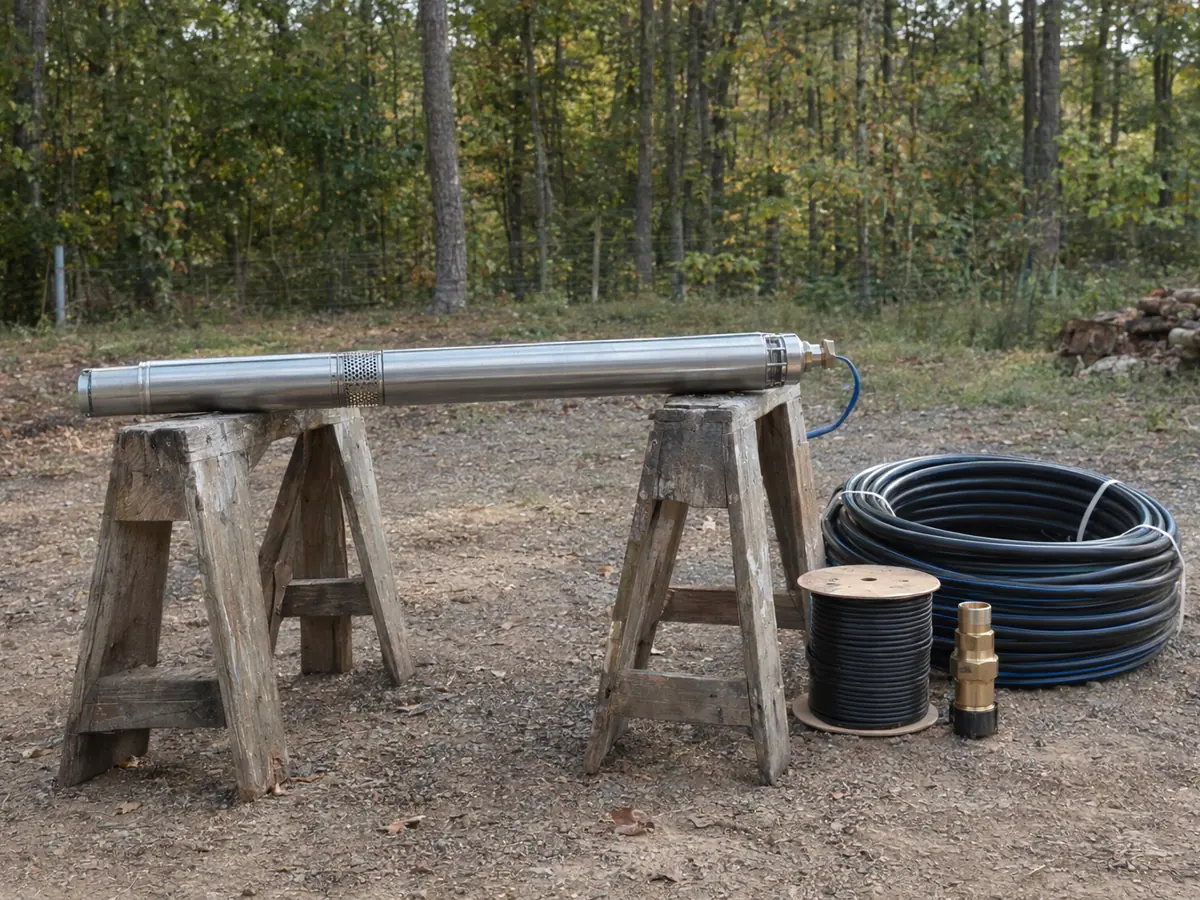
Well pump replacement is more than trading one motor for another. The new pump has to suit the well, the house, and the wiring already in the ground, and every part that comes up with the old one gets a look.
Submersible and jet pumps are built for different wells
Most wells here are drilled into rock, and most of those run a submersible pump. It hangs deep in the well at the bottom of the drop pipe, pushes water up instead of pulling it, and works out of sight.
A jet pump lives above ground, often in a pump house or under the house, and lifts water by suction. A shallow-well jet only works when the water stands close to the surface. A deep-well jet sends water down one pipe to an ejector in the well and brings it back up a second pipe. Jet pumps are easy to reach, but they are noisier and can lose their prime.
When we replace a pump, we usually stay with the type the well was set up for. Converting from jet to submersible is possible and sometimes worth doing, but it changes the pipe, the wire, and the wellhead, so we treat it as its own decision.
Two-wire or three-wire: where the starting parts live
Submersible motors come in two common wiring setups. The count leaves out the ground wire.
A two-wire pump has its starting parts built into the motor. There is no control box, only the pressure switch feeding the well wire. Fewer parts up top, but if a starting part fails, the whole pump has to come out.
A three-wire pump keeps its start capacitor and relay in a control box near the tank or the panel. Those parts take the beating from hard starts and power surges, and they can be swapped without opening the well. The box has to match the motor's make and size, so a new three-wire pump often comes with a new box.
If the wire already in the well is sound, we generally keep the same setup. If it needs replacing anyway, you have a real choice, and we will walk you through the trade-offs.
Sizing a new pump to the well and the house
Bigger is not better with a well pump. One that moves more water than the well can supply pulls the level down to the intake, sucks air, and runs hot. One that is too small leaves you with a weak shower whenever someone else opens a tap.
Getting it right takes measurements and a few questions:
- How fast the well refills. In Piedmont bedrock that depends on which fractures the well crossed, so we test it.
- Where the water stands at rest, and how far it falls while the pump runs.
- How deep the pump hangs and how far uphill the house sits from the well.
- The pressure range you want at the taps.
- How the household uses water: bathrooms, irrigation, livestock, or a pool to fill.
The pump is then chosen from the maker's performance charts. If the old pump was too big for the well, the replacement may be smaller, and the house will work better for it.
What comes up the well with the old pump
Pulling a pump brings up everything attached to it.
- Drop pipe. The pipe the pump hangs from and pushes water through. Older wells may still have galvanized steel, which rusts from the inside, faster in iron-rich or acidic water. Newer setups use plastic pipe. We check threads, couplings, and clamps for cracks and wear.
- Well wire. The cable from the wellhead to the motor, taped along the pipe. We look for nicks, rubbed spots, and the condition of the splice at the motor.
- Check valves. These hold the column of water in the pipe when the pump stops. A worn one lets pressure bleed off, causes banging in the lines, or starts the pump when nobody is using water.
- Pitless adapter. The fitting in the side of the casing, below the frost line, joining the drop pipe to the buried line to the house. Its O-ring wears and can leak pressure back into the well.
- Torque arrestor. A rubber collar on the pipe just above the pump. A motor twists hard when it starts, and the arrestor keeps the pump centered so it does not knock against the casing.
Worn pieces get replaced now, because this is the one good chance to reach them.
What pulling a submersible pump actually involves
Power is shut off at the panel first. Then the cap is lifted off the casing, and a pulling pipe threads into the pitless adapter so the assembly can be unseated and lifted.
A shallow pump on plastic pipe can come up by hand. A deep pump on long runs of pipe is heavy and takes a pump hoist. Pipe and wire come up together and are laid out on a tarp or clean ground, never in loose dirt, so grit does not ride back into the well.
A pump dropped down a well is a serious problem, and fishing one out is slow, uncertain work. A safety rope tied to the pump and a steady hand on the pipe keep that from happening.
None of this is homeowner work. The assembly is heavy, the wire is live until it is disconnected, and an open well is easy to contaminate.
Constant-pressure systems as an upgrade option
A standard setup runs the pump flat out from cut-in to cut-out, so pressure at the tap rises and falls as the tank fills and empties. A constant-pressure system uses a variable-speed drive, which changes the pump's speed from moment to moment to keep pressure even.
The upside is real. Showers stay even when another tap opens. The motor starts gently instead of slamming on. A smaller tank does the job. It suits houses with irrigation, several bathrooms, or long pipe runs.
There are trade-offs. The drive is electronics on the wall, and electronics do not like lightning, so surge protection matters. The motor has to be compatible with the drive. On a low-yield well, the drive has to be set so it cannot run the well dry. We can lay out a constant-pressure option next to a standard setup so you can compare.
Disinfection and the rules that apply after pump work
North Carolina requires a certified well contractor to be present for well contractor work, including breaking the well seal and disinfecting the well. We hold a North Carolina water well contractor certification (2453-A) and a Virginia water well license (2719001436).
The state's well construction rules also say the well must be disinfected afterward by whoever installed or repaired the pump. The chlorine has to reach at least 100 parts per million in the well and stand for 24 hours or more, and then the well is pumped until no chlorine shows up before the water goes back into use. On the Virginia side, the state's rules call for disinfection after any work that needs access to the inside of the casing.
Permits are a separate question. North Carolina law does not require a repair permit to replace a well pump. In Virginia, replacing a pump is not counted as altering the well, so the state's well construction permit does not come into play for a pump swap. Work that goes beyond the pump can be different, and we will tell you if a permit is involved.
Why a failing pump is worth replacing before it quits
Once the readings say a pump is on its way out, it will not recover. Waiting tends to make the eventual job bigger.
A motor drawing high current is cooking its own windings and the splice beside it. Keep running it, and what could have been a straight well pump replacement turns into a pump, wire, and control box job. A worn pump runs longer and longer to fill the tank, adding heat and hours to a motor that is already tired. And when it finally stops, it does so without notice, which turns a planned replacement into a no-water call with a dry house.
Planning ahead also leaves room to test the well's recovery first and weigh a constant-pressure setup. Those choices are hard to make with no water and a kitchen full of dirty dishes.
Install day from your side of the yard
- Scheduling. We set the day and let you know the water will be off for part of the visit.
- Setup. The truck parks as close to the wellhead as the yard allows, and tarps go down where the pipe will be laid out.
- Shutoff and pull. Power to the pump is turned off, and the old pump, pipe, and wire come up.
- Show and tell. We show you what failed and any worn parts found on the way up, and confirm what is being replaced.
- Assembly. The new pump goes on with a fresh splice, check valve, and torque arrestor, plus any pipe and wire that need replacing.
- Back down the well. The assembly is lowered, seated in the pitless adapter, and the well cap goes back on snug.
- Startup. We check voltage and amp draw, watch the pressure switch cycle, and set the tank's air charge to match the switch.
- Disinfection. The well is chlorinated. You will smell it at the taps, and we will explain when and how to run it out of the system.
Expect cloudy or discolored water at first while things settle. It clears as the lines flush. When you are ready to talk through a replacement, call (336) 613-4314.