
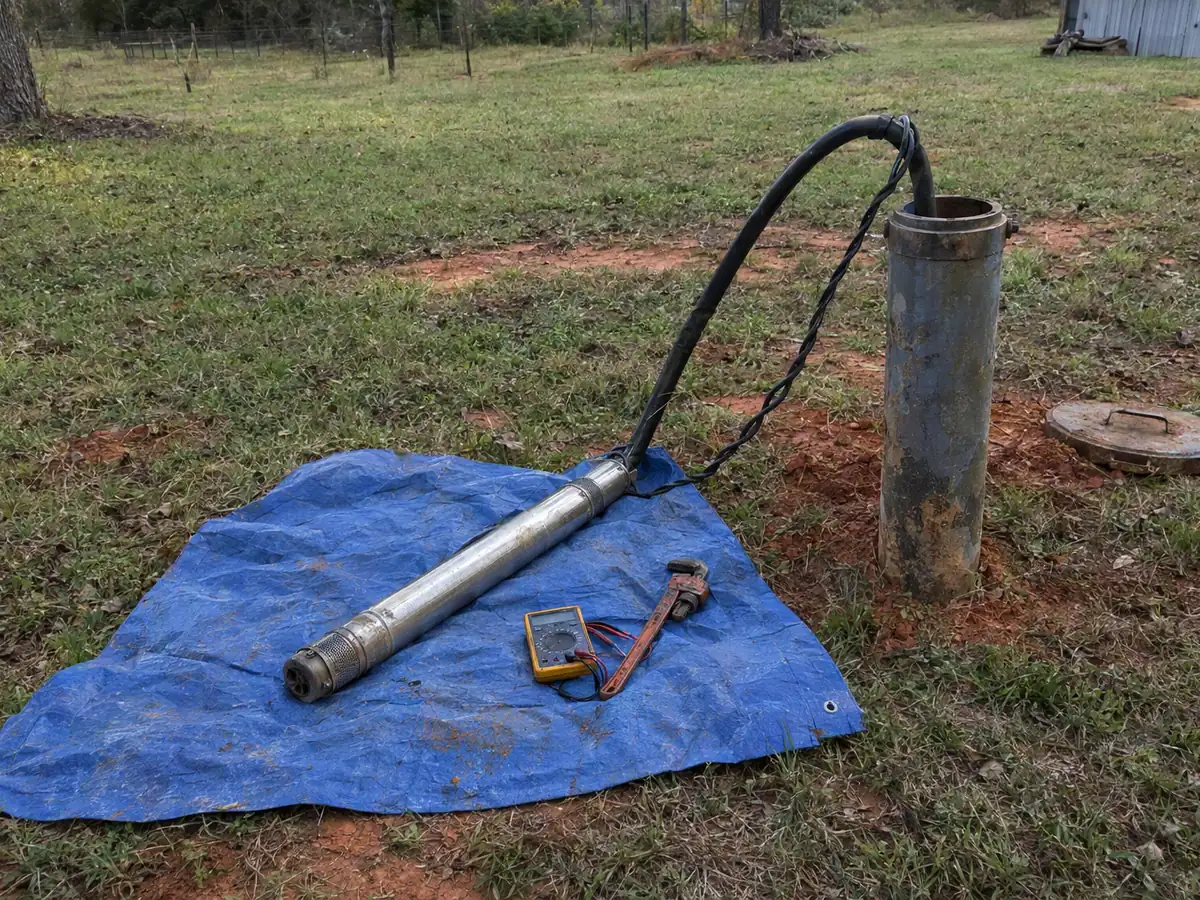
Each of these usually starts with one failing part, and the job is finding which one before anything gets pulled out of the ground. Our well pump repair work starts at the breaker and works down the well, one part at a time.
Reading the symptoms your pump is giving you
Pumps rarely quit without warning. The same complaint, though, can come from a part next to the tank or one far down the well.
Low pressure
A weak shower, or a tap that never really gets going. A worn pump can still run without pushing hard enough. Iron scale in the pipe, a clogged filter, or a hole in the drop pipe can feel the same from the house.
Sputtering and air
Spitting taps and bursts of air mean the pump is moving air along with the water. Sometimes the water in the well has been drawn down to the pump. Sometimes a leak in the pipe, or a check valve that will not hold, lets air into the line between cycles.
Short cycling
The pump clicks on, runs a few seconds, and shuts off, over and over. A waterlogged pressure tank is the usual cause. A leaking check valve or a pitless adapter seal that has let go can do it too.
The pump runs but no water comes
The switch clicks on, the pump keeps running, and the taps stay dry or barely trickle. Think pipe and water level. A drop pipe that has split or come apart, a pump worn out inside, or a well that has been pumped down all look like this from the house.
Breakers that trip, or dead silence
A breaker trips because something is drawing more current than it should: a shorted motor, a splice that has taken on water, a failed part in the control box, or a pump jammed with grit. Dead quiet with the breaker on usually means burned switch contacts, a control box knocked out by lightning, or a motor that has stopped for good.
What Piedmont rock and weather do to well pumps
Wells in this region are mostly drilled into hard rock. USGS describes Piedmont bedrock as dense and nearly watertight, giving up water mainly through fractures that sit under a layer of weathered rock and soil. A well's supply depends on how many of those fractures it crossed and how fast they refill. In a dry summer, a well that keeps up fine in April can get pumped down, and a pump short on water runs hot.
Storms are the second problem. Lightning that hits near a well can travel through the ground, the casing, and the power lines into the pump circuit. Control boxes, pressure switches, and motors take the damage, and it does not always show right away.
USGS also notes that iron and manganese reach objectionable levels in parts of the Piedmont, and NC DHHS reports that Piedmont counties had the highest average manganese levels in the state. Both settle out as orange and black buildup on check valves, pump intakes, switch tubes, and pipe walls. Over time that scale chokes flow and makes moving parts stick.
The order we check things in, top to bottom
The pump is the hardest part of the system to reach, so it is the last thing we condemn. We start at the panel and work down.
- Power. Is the breaker on, and is full voltage reaching the pressure switch? A loose connection or a worn-out breaker can look exactly like a dead pump.
- Pressure switch. Do the contacts close at cut-in and open at cut-out? Is the small tube under the switch plugged?
- Control box. Three-wire pumps keep their start capacitor and relay here. They fail often, and they can be replaced without opening the well.
- Wiring. Meter readings taken at the surface tell us whether the wire down the well and the motor windings are sound, shorted, or broken.
- Pump. Amp draw and output show whether the motor is healthy and whether the pump is still moving the water it should.
- Drop pipe. If the pump runs and pressure will not build, we look for a split pipe, a failed coupling, a bad check valve, or a leaking pitless adapter seal.
- Well level. We measure where the water sits. A healthy pump cannot deliver water that is not there.
Each step either finds the fault or clears that part, so nothing gets replaced on a hunch.
Fix the part or replace the pump: how that call gets made
A lot of well pump repair never touches the pump itself. A burned switch, a dead capacitor, or a waterlogged tank gets repaired, and the pump goes right back to work. When the readings point down the well, the decision takes more thought.
A submersible motor with a shorted or open winding is not fixed in the field. It gets replaced. A pump that runs but has worn out inside, with low amp draw and weak output, is close to the end as well. We also weigh its age, how much iron and manganese scale it is carrying, and whether it has been running dry because it is bigger than the well can feed.
Sometimes the pump is fine and the fault is a split pipe or a bad splice. If the pump is already out for that repair, we will tell you what we see on it, and you can choose to put it back or replace it while everything is open. You see the readings and the worn parts. You make the call.
What happens if you keep running a struggling pump
A pump that is short cycling or running low on water does not hold steady. It gets worse, and it tends to take other parts down with it.
Every start pulls a heavy surge of current. A pump that starts far more often than it should wears out its motor, its capacitor, and the switch contacts long before their time. A pump that keeps running with too little water overheats, because the water moving past the motor is what keeps it cool. Push that long enough and the motor fails outright.
A split drop pipe can keep the pump running nonstop, since pressure never climbs to the cut-out point. Burned contacts get hot enough to scorch the switch and the wire ends feeding it.
And failing pumps pick their own timing. The one limping along now tends to quit on a holiday weekend, in a heat wave, or the morning the house is full of guests.
When we come out: a pump service call, step by step
It starts on the phone. We ask what you are noticing, when it started, whether there was a storm, and whether a breaker has tripped. Your answers shape what we bring.
At the house, the technician begins at the panel and the pressure switch, then the control box if there is one, with a meter on each part. You will see us check pressure at the tank and watch a full pump cycle, on and off.
If everything above ground checks out, we take readings on the well wire at the wellhead. Those numbers usually tell us whether the trouble is in the wire, the motor, or the pipe before the well cap comes off.
Then we stop and explain. You hear what failed, what we think caused it, and what your options are. Nothing is pulled or replaced until you say so.
If the pump does come out, the pipe and wire get laid out clean on the ground and inspected piece by piece. North Carolina's well rules require anyone who repairs or installs a pump to disinfect the well when the work is done, so that happens before we leave. Last, we run the system through its cycles and show you where the pressure should sit.
Water quality after the well has been opened
A well is meant to stay sealed. Opening it lets in air, tools, and hands. NC DHHS says well water should be tested after the repair or replacement of any well component, because contaminants can get in while the well is open.
The disinfection after pump work is meant to kill anything that got in during the job. A lab test afterward is how you know it worked. We can collect that sample and go over the lab results with you in plain language.
Safe checks a homeowner can make first
A few things are worth looking at before you call, and none of them involve opening anything.
- Find the breaker for the well pump. If it has tripped, give it one reset. Should it trip a second time, leave the handle down.
- Read the gauge on the pressure tank, if there is one, and write the number down.
- Think back. Was there a storm, a power outage, or new work on the property?
- If you have a whole-house filter, note when the cartridge was last changed. A plugged one causes low pressure.
- Listen near the tank for rapid clicking from the pressure switch.
Leave the switch cover, the control box, and the wellhead alone. They carry line voltage, and a well cap is not something to remove on your own. Call Piedmont Well and Water Services at (336) 613-4314 with what you found.