
Most of the city drinks from three lakes in northern Guilford County, so plenty of people never think about a well until they buy a house with one.
Where the city mains end and private wells begin
The City of Greensboro runs the public water system, and its three main sources are Lake Higgins, Lake Brandt, and Lake Townsend, all up in the northern part of the county. Inside city limits, most taps are on that supply.
What we can tell you is where wells get thicker. Guilford County's long-range plan, adopted in 2025, notes that the two big cities are the densest places in the county and that homes spread out as you move away from them. The county does not sell water itself, and the plan points to private wells and septic systems for the areas unlikely to get community lines. That outer ring is where most of our work in town happens.
A mailing address will not settle the question. The Iron Ore Belt Access at Haw River State Park carries a city address in the 27455 ZIP code, and that park sits about 15 miles north of the city.
What the rock under Guilford County gives a well
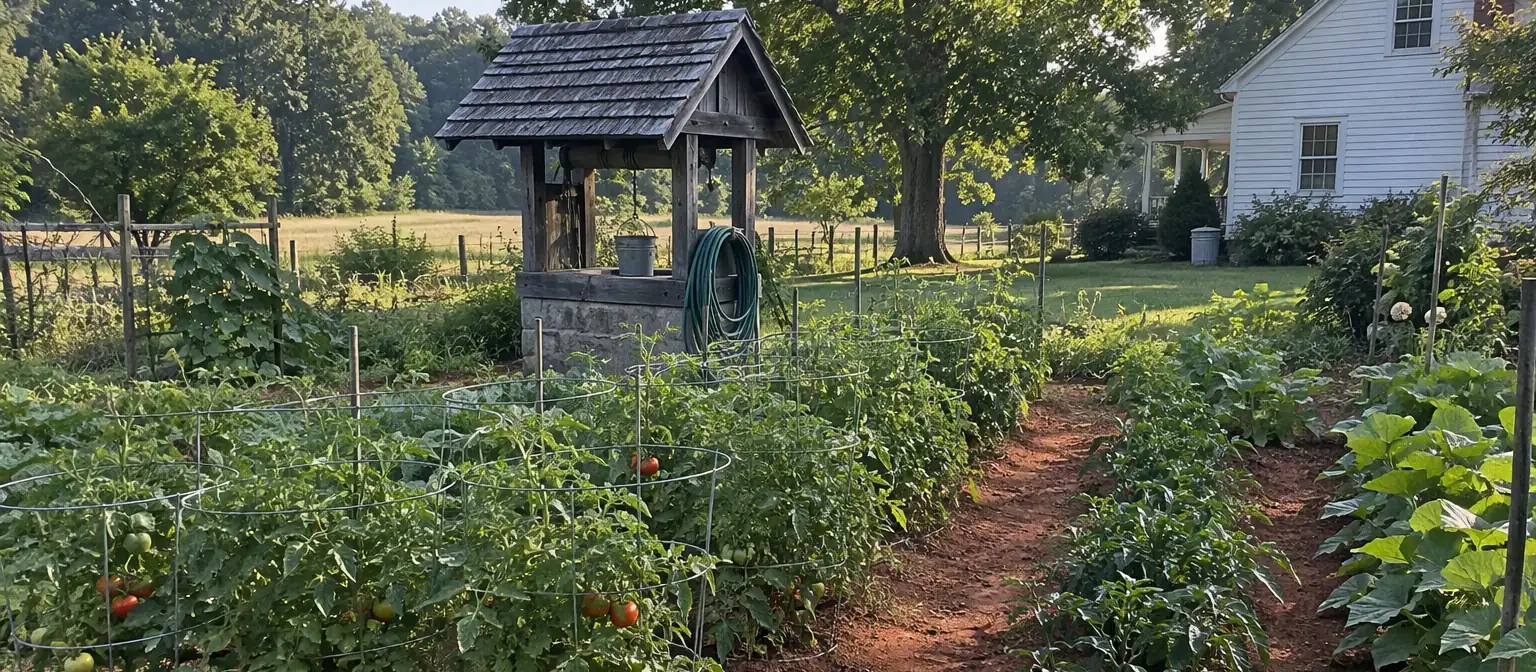
Wells around here are drilled into bedrock, and the water comes out of cracks in that rock. The USGS describes the Piedmont as dense, nearly watertight stone that gives up water mainly through fractures, under a blanket of weathered rock and soil called regolith. Next-door neighbors can end up with wells that behave nothing alike, because each bore found its own fractures.
The rock sets the chemistry, too. NC DHHS reports that Piedmont counties had the highest average manganese levels in the state, and it names Guilford among the counties with the highest averages. Manganese leaves brown-black stains and a bitter, metal taste. The USGS also lists iron as a local problem in Piedmont groundwater, and iron stains orange. We go by a lab result, never a guess.
Groundwater is not a small thing in this county. A 2007 county health report estimated that about 135,000 Guilford residents drew household water from the ground in 2006, up from roughly 74,460 in 1990. Those figures are old, but they show how many families lean on a pump and a tank.
Four calls we hear from the edge of town
- The house purchase. A buyer learns the lot they are closing on has a well and wants to know its shape. We run an inspection with a drawdown and recovery test and look over the pump, tank, switch, and wellhead.
- The tank that clicks on and off. A waterlogged pressure tank makes the pump start and stop every few seconds. That short cycling wears out pumps and switches early.
- The pump that quit after a storm. Lightning and power surges take out pumps and control boxes. A three-wire pump has a control box indoors and a two-wire pump does not, so the fix is different.
- Black rings in the tub. Usually manganese. We test first, then talk filters or a softener.
How the county well office works since July 2026
Well permits and well water sampling for the whole county run through Guilford County Environmental Health, Water Quality Section, at 400 W. Market St., Suite 300, in Greensboro.
The rules behind those permits changed this year. Session Law 2026-32, signed July 2, 2026, made the state's private drinking water well program the single set of permitting and inspection rules for North Carolina and barred local health departments from enforcing their own. Guilford had kept local well rules since 1989, and its drinking water well rules were repealed the day the law was signed. County staff still issue the permits and inspect the work. They now enforce the state standards. Local rules for wells that do not supply drinking water were left alone.
For a homeowner, the line that matters is simple. State law does not require a repair permit to repair or replace a pump or tank, or for maintenance that leaves the well seal closed. Repairs to the well itself, such as casing work, go through the county.
Starting from our own home base
We are based in the city, at a 27407 address, so this is where our day starts. From here we head out on I-40, I-85, I-73, US 29, US 220, US 421, and US 70, which puts every corner of the county in reach, along with nearby towns like Summerfield, Jamestown, McLeansville, Browns Summit, and Colfax.
Office hours are Monday to Friday, 8am to 5pm, and we keep the schedule. On Saturday and Sunday, call or text (336) 613-4314. Tell us the address, what the water is doing, and whether the pump breaker has tripped, and we will work out the next step with you.
Six jobs we handle around Greensboro
- Pump repair: we trace low pressure, no water, and short cycling to the part that failed, whether that is the pump, switch, control box, or wiring.
- Pump replacement: when a submersible or jet pump is done, we set a new one matched to the well and disinfect the well afterward, as state rules require.
- Pressure tanks: we swap failed tanks and pre-charge each new one to roughly 2 psi under the switch's cut-in setting.
- No-water emergencies: say the taps are dry when you call so we can treat it as the emergency it is.
- Well and casing repair: cracked casing, a loose cap, or a wellhead cut too low gets fixed, with a county permit when the work calls for one.
- Water treatment: after a lab test, we fit filters, softeners, or disinfection to what is actually in the water.
ZIP codes we cover around Greensboro: 27395, 27401, 27403, 27405, 27406, 27407, 27408, 27409, 27410, 27455, 27495.