
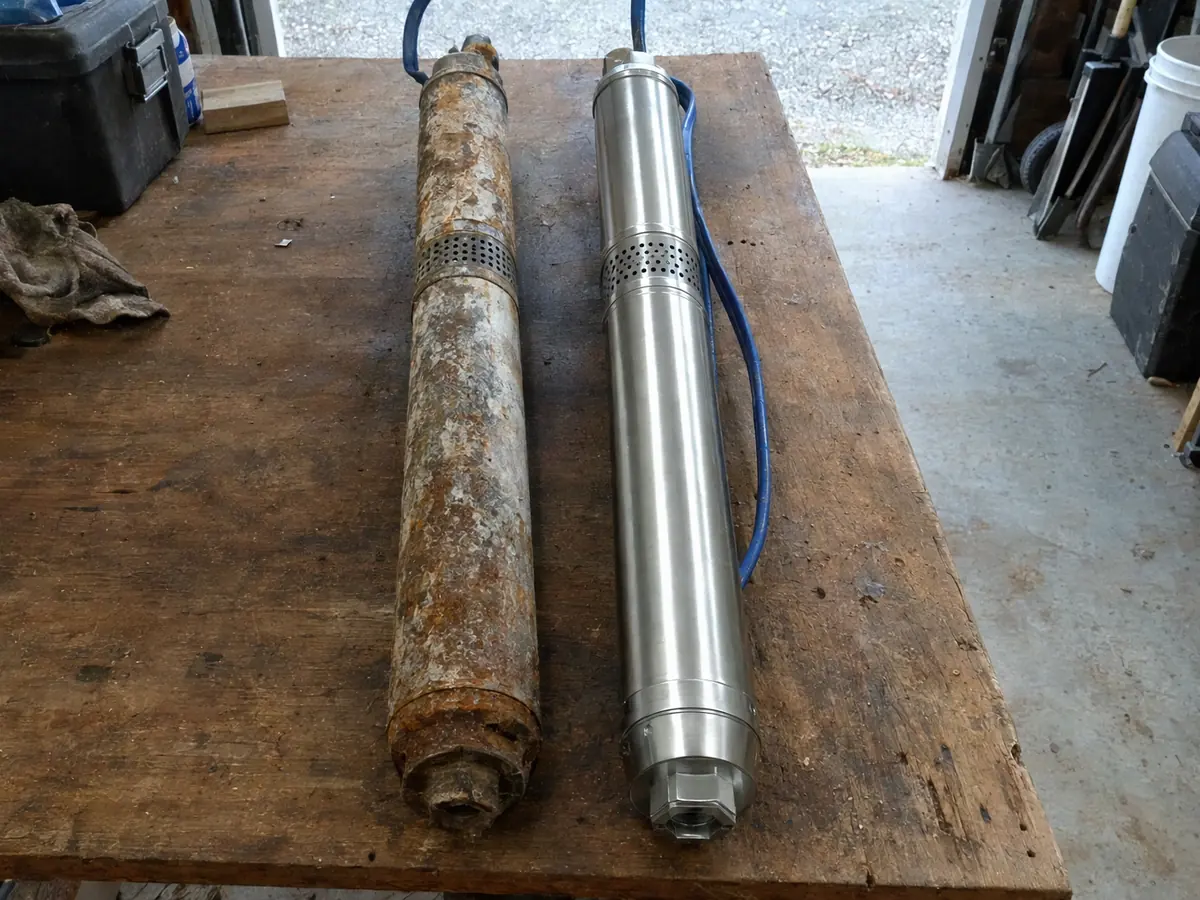
The honest answer depends on what broke, how old the rest of the system is, and what the well itself can deliver. Below are the factors that matter when you repair or replace well pump parts, tanks, or the well.
Pin down exactly what failed
Most bad decisions start with a guess. A house with no water could have a dead motor, a burned control box, a broken wire splice down in the well, a failed pressure switch, or a well that has run low. Only one of those calls for a new pump.
A good diagnosis checks the easy-to-reach parts before anyone pulls a pump: power at the switch, the switch itself, the control box on three-wire systems, and the tank's air charge. Electrical readings taken at the surface can also show whether the motor windings and the wire down the well are sound, without hauling anything up.
Pumps: when fixing still makes sense
Lean toward repair when
- The failure is above ground: a pressure switch, a control box part, or a wiring connection.
- The pump has run well until a single event, like a surge that took out a control box.
- A jet pump needs a seal or a part that is still easy to get.
Lean toward replacement when
- The submersible motor itself has failed. In home wells, these sealed motors are replaced rather than rebuilt.
- The pump is old and already out of the well for another reason. Pulling a pump is the hard part of the job, and reinstalling a tired one may mean pulling it again soon.
- It has worn to the point it no longer keeps up, or it has failed more than once.
- It was the wrong size from the start, either too weak for the house or too strong for the well.
Tanks and switches are usually a swap
A pressure tank that has only lost its air charge can be recharged, and that is the first thing to check. A tank with a torn bladder or diaphragm, a rusted shell, or leaking seams gets replaced. On most home tanks, the bladder is not a part anyone services.
If you are replacing a pump, look hard at the tank too. A new pump on an old waterlogged tank will short cycle from its first day. The reverse holds as well: a new tank will not save a pump that is already failing.
Pressure switches wear out from years of contact arcing and are replaced, not repaired. When the pump or tank gets replaced, swapping an aging switch on the same visit is common sense.
Deciding what to do about a weak or damaged well
A well that gives less water than it used to can often be helped without starting over. Rehabilitation can restore lost flow, and in Piedmont bedrock, hydrofracturing can reopen or extend the fractures that feed a drilled well. A drawdown and recovery test comes first, to show whether the shortfall is the well or the equipment.
Casing damage is a repair question first. A cracked or corroded casing can often be fixed with a liner or an extension. North Carolina rules are blunt about it: defective casing, seals, or wellhead parts must be repaired or replaced, or the well must be permanently abandoned.
A new well becomes the answer when testing shows the rock cannot supply the house, or the old well cannot be made safe.
Permits and rules that shape the choice
North Carolina does not require a repair permit to repair or replace a well pump or tank, or for maintenance that does not break or open the well seal. Repairing or abandoning the well itself is different, and falls under the county health department's well program. Whatever the job, NC rules require the well to be disinfected after a pump is repaired or installed.
In Virginia, replacing a well pump is not considered an alteration. Constructing, altering, deepening, or abandoning a well does require a written permit. Both states require the people doing well work to hold the proper certification or license.
Questions to ask before you approve a replacement
- What exactly failed, and how did you test it?
- Can I see the old part once it is out?
- If we repair it, what else in the system is close to the end of its life?
- Is the replacement sized for my well's yield and my household, or just matched to the old one?
- Will the well be disinfected and the water tested afterward?
Piedmont Well and Water Services repairs and replaces pumps, pressure tanks, switches, and control boxes, and handles casing repair, liners, and well rehabilitation. Our founder has been a licensed tradesman since 1974. If you are weighing a repair against a replacement, call (336) 613-4314 and talk it through.