
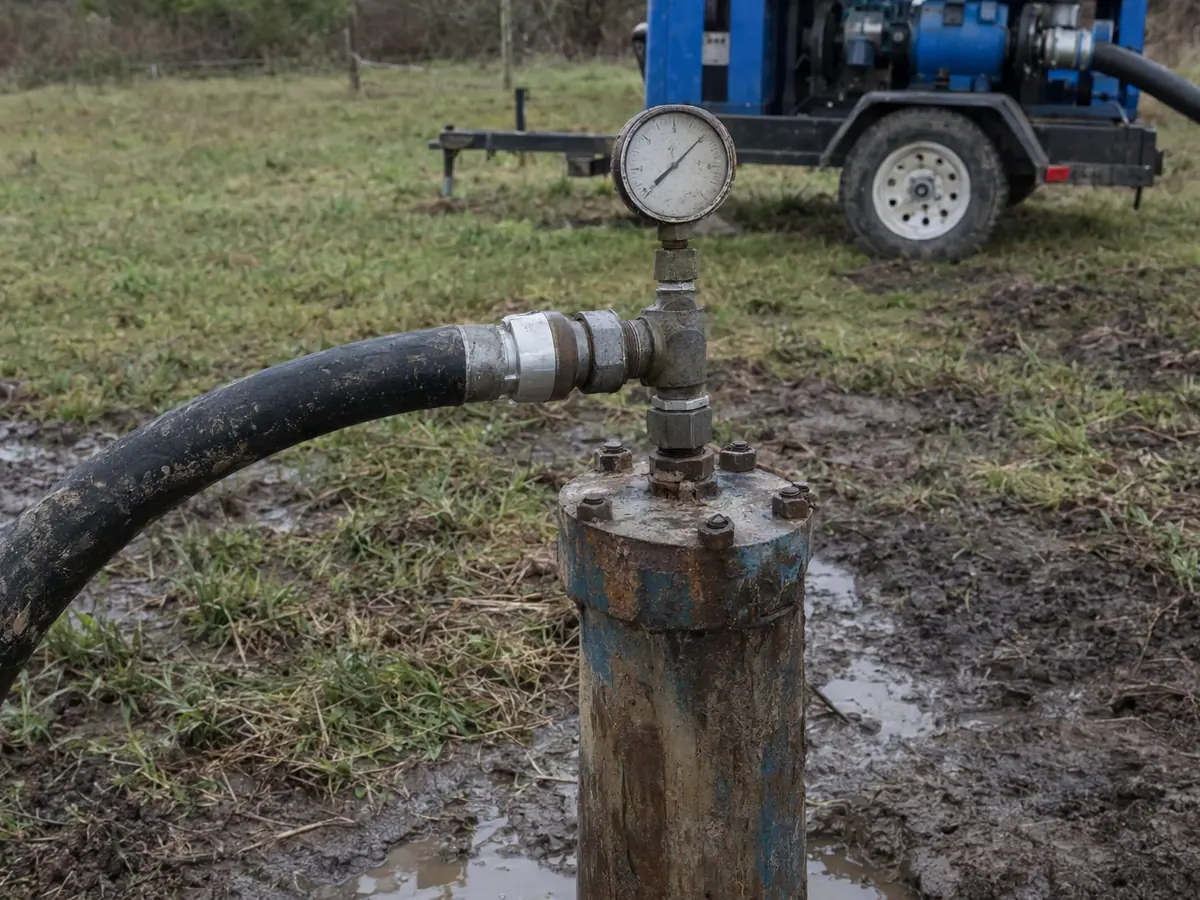
It does not create water. It helps the well reach water that is already there but not getting through.
Why Piedmont wells depend on cracks in the rock
The U.S. Geological Survey describes most Piedmont bedrock as dense and almost impermeable. Water moves through it mainly along fractures, the only effective openings in unweathered rock. Above it sits a blanket of loose material USGS calls regolith: saprolite (rock that has decomposed in place), plus soil and other deposits. That layer soaks up rain and feeds the fractures below.
A drilled well here is only as good as the cracks it crosses. Hit several open, connected fractures and it may give plenty. Cross a few tight ones and it may barely keep up with a household. USGS also notes that well yields in these rocks run low compared with other bedrock in the region, because the water is limited to fractures.
How a well is hydrofractured, in plain words
- The pump, wire, and drop pipe come out so the borehole is open.
- A packer, a heavy rubber seal, is lowered into the open rock below the casing and inflated to close off a section of the hole.
- Clean water is pumped into that section under high pressure. It pushes into existing fractures, flushes out silt and mineral buildup, and can widen or extend them until they connect with other water-bearing cracks.
- The process may be repeated at more than one depth.
- The well is flushed, the pump goes back in, and the well is disinfected before it returns to service.
The Connecticut Department of Public Health, in its private well guidance, sums it up: high pressure applied at various depths opens water-bearing fractures and increases a well's yield.
What pressure can change and what it cannot
Hydrofracturing works on the rock. It can clear clogged fractures, open tight ones, and link the well to cracks it narrowly missed. It cannot add water to ground that holds little, and nobody can predict exactly how much it will gain. Results vary from well to well, and an honest contractor will not promise a number.
It also does nothing for problems outside the rock. A worn pump, a leaking drop pipe, a failing pressure tank, or a cracked casing can all make a well seem weak. Fracture a well with a bad pump and you still have a bad pump.
When hydrofracturing is worth a serious look
- The well used to do better. A drilled well that once kept up and slowly fell off may have fractures clogged with silt, iron, or scale. Clearing them is exactly what the process is for.
- The yield is low but not zero. A well that gives some water, just not enough, has fractures to work with.
- Testing has ruled out the equipment. The pump and lines check out, and the shortfall is in the well itself.
- The other choice is a new well. A new well is a much bigger project, with no promise of better luck in the same rock.
When it is probably not the answer
- Bored or dug wells. These wide, shallow wells sit in soil and saprolite, not bedrock, so there is no rock for a packer to seal against.
- A drought. When the water table drops across an area, opening fractures cannot reach water that is not there right now.
- Water quality complaints. Bacteria, staining, or a rotten-egg smell call for testing and treatment, not more flow.
- A damaged well. Cracked or failing casing needs repair first.
Questions to settle before anyone fractures your well
Start with a drawdown and recovery test. It measures how far the water level falls while the pump runs and how fast it comes back, which shows whether the well is truly short of water and gives a baseline to judge any gain against.
Then check who is doing the work. In North Carolina, hydrofracturing is a well contractor activity that requires a certified well contractor. Any Level A or Level B certified contractor may legally do it, but not every one has the equipment or offers the service. Certified contractors carry a wallet card with a photo and the dates their certification is valid, and you can ask to see it.
Piedmont Well and Water Services does drawdown and recovery testing, well rehabilitation, and hydrofracturing on drilled wells. If yours has slowly lost ground, call (336) 613-4314 and start with a test.