
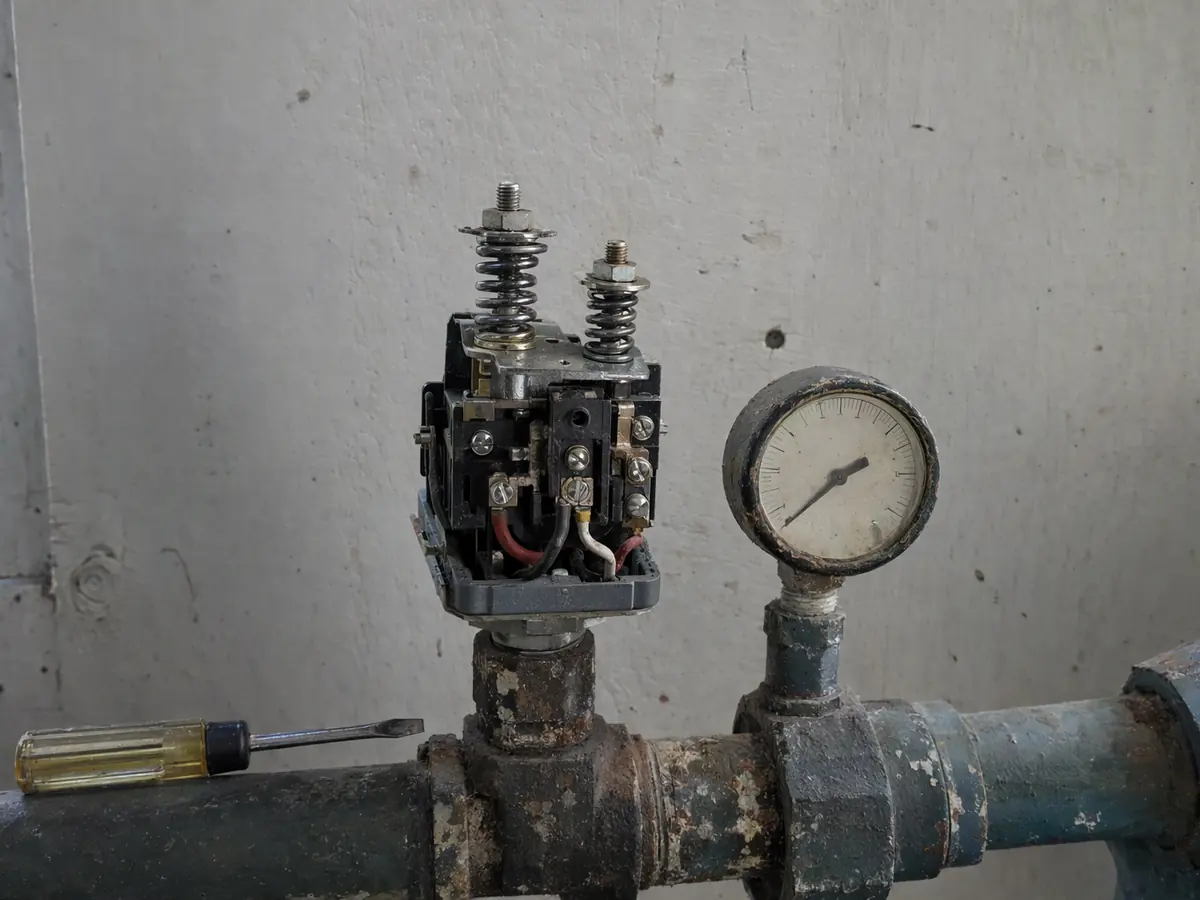
When it fails, or the control box or wiring behind it does, the house can act like the pump is dead. Pressure switch repair, control box work, and most wiring fixes happen above ground, once testing shows which part failed.
Cut-in, cut-out, and what the switch is reading
Your pressure switch watches the pressure in the tank and the pipes. Use water, pressure falls, and at the cut-in point the switch closes its contacts and the pump starts. The tank refills, pressure climbs, and at the cut-out point the contacts open and the pump stops.
Those two numbers make up the switch setting. Common settings are 20/40, 30/50, and 40/60 psi. The tank's air charge is set about 2 psi below the cut-in, so the tank and the switch work as a pair. When the tank's charge is off, the switch often takes the blame for a problem it did not cause.
Turning a switch up for more pressure is not a small change. The pump has to be able to reach the new cut-out, and the tank charge has to follow. Set it too high and the pump can run without ever reaching shutoff.
Signs the fault is in the controls, not the pump
Trouble in the controls tends to show up in a few recognizable ways:
- Rapid clicking or chattering from the switch while water is running.
- A pump that will not shut off, with the tank gauge climbing past its usual top number.
- No water, and no click from the switch when pressure drops.
- A breaker that trips the moment the pump tries to start.
- A jet pump that hums but will not turn.
- A burning smell, or buzzing, near the switch or the control box.
- Water that quit during or right after a storm.
Any of these can also start somewhere else in the system, which is why testing comes before parts. Still, they send us to the switch and the box first.
Burned contacts, plugged tubes, and ants
A pressure switch is a simple part, and it fails in a handful of familiar ways.
Pitted or burned contacts
Each time the pump starts, a small arc jumps across the contacts. Over thousands of cycles, that arc pits the metal and burns it black. Burned contacts can fail open, so the pump never starts, or weld shut, so it never stops. A waterlogged tank that short cycles the pump wears them out much sooner.
A clogged sensing tube
The switch reads pressure through a small fitting or tube underneath it. Iron, manganese, and grit collect there. USGS reports that iron and manganese occur at objectionable levels in some Piedmont groundwater, and this narrow passage is often where that buildup causes trouble first. A plugged tube makes the switch react late or not at all.
Insects
Ants are drawn to the contacts, and one crushed between them can keep the switch from closing. Spiders and wasps move into switches in pump houses and crawl spaces too. The result is a switch that works one day and not the next.
Low-pressure cutoff switches and why they trip
Some pressure switches have a small lever on the side. That lever means the switch doubles as a low-pressure cutoff. If pressure falls well below cut-in, it shuts the pump off and holds it off until someone resets it by hand.
The cutoff is there to protect the pump. Pressure that low usually means something has gone wrong: the well has been pumped down, a line has broken, or the pump is too worn to build pressure. Shutting down keeps the motor from running dry or pumping water into a break.
A cutoff that trips once after a long outage may only need resetting. One that trips again and again is reporting a real problem. Leave the lever alone and call. It sits right next to live terminals, and forcing a pump to run against whatever tripped the cutoff can finish off the motor.
The control box on a three-wire pump
A three-wire submersible pump has a control box, usually mounted on the wall beside the tank or the breaker panel. Two-wire pumps do not have one, since their starting parts are down in the motor.
Inside the box are a start capacitor and a relay. The capacitor gives the motor an extra kick to get it turning. The relay takes the capacitor out of the circuit once the motor is up to speed. Larger boxes can also hold a run capacitor and an overload.
When the capacitor fails, the motor cannot start. It strains, pulls far more current than normal, and the overload or the breaker cuts it off. When the relay sticks, the capacitor stays in the circuit too long, overheats, and fails, sometimes bulging or leaking. Both are replaced right at the box, with no need to pull the pump. The box and its parts must match the motor, so we confirm the motor's specifications before anything is swapped.
Wire, splices, and lightning strikes
Wire runs from the switch or the control box out to the wellhead, then down the well to the motor, where it is joined to the motor leads with a waterproof splice. Splices are the weak link. Once water gets into one, current leaks to ground and the breaker trips. Wire can also be nicked against the casing or rubbed through where it was taped to the pipe.
From the surface, a meter reads the resistance of the wire and the motor windings and checks whether the insulation is leaking to ground. That tells us whether the fault is up top or down the well before anything comes out.
Lightning and power surges are a common cause of control failures. A nearby strike can come in on the power lines or up through the ground and the well casing. Switch contacts, capacitors, relays, and splices take the hit first. After a storm we test all of them, because finding one burned part does not mean it was the only one.
Why the switch and box covers should stay on
A pressure switch has full line voltage on its terminals whenever the breaker is on. The control box does too, and a capacitor can hold a charge even after the power is off.
It is tempting to pop the cover and tap the contacts or turn the spring nuts. Please do not. Adjusting the springs without matching the tank charge throws the whole system off, and a screwdriver slipping across live terminals can hurt you badly. If you see scorch marks, smell burning, or hear buzzing, switch off the pump breaker and leave it off.
What you can safely do is read the tank gauge, listen for the click, check the breaker, and then describe for us what you noticed and when it started.
What a chattering switch turns into if it is left alone
A switch that chatters, sticks, or reacts late does not stay that way. Each fault grows in its own direction.
Chattering contacts arc every time they bounce, and that arcing burns them far faster than normal use. Contacts that weld shut leave the pump running when it should stop. It keeps pushing against a full tank, pressure climbs, the motor heats, and the tank and fittings carry more pressure than they were built for. A plugged sensing tube can cause the same runaway. On the motor side, a capacitor that is failing slowly makes every start harder, and every hard start heats the windings down in the well.
Small controls problems also hide bigger ones. A switch that keeps burning up often points to a waterlogged tank or a well running low. A box that keeps losing capacitors may be pointing at a motor on its way out. Catching that early is the difference between replacing a part and replacing a pump.
How a controls service call goes
Piedmont Well and Water Services handles switches, control boxes, and well wiring on both submersible and jet systems. A controls call follows the same pattern each time.
The technician looks before touching anything: the tank gauge, the breaker, the switch housing, and the control box. Scorch marks, a swollen capacitor, or an ant nest under the switch cover tell part of the story right away.
Next comes live testing. With the covers off, which is our job and not yours, we confirm voltage at the switch and the box, watch the contacts open and close, and compare the actual cut-in and cut-out against the gauge.
Then the well wire gets metered, at the box or the wellhead. If the wire and motor test good, the fault is above ground. If they do not, we explain what that means before any further work.
The pressure switch repair itself, or the control box or wiring fix, happens right there: a new switch, a cleared or replaced sensing tube, a new capacitor or relay, or a tightened connection. The system then runs through several full cycles while we watch pressure and current. Last, we check the tank's air charge against the switch setting, since fixing one without the other invites the problem back. To set up a visit, call (336) 613-4314.